

For a student whose decoding lags years behind their thinking, every test is secretly two tests: the one you wrote, and a reading test they did not sign up for. Read aloud in Pear Assessment removes the secret second test. The text-to-speech support reads passages and questions to the student inside the test player, with play and stop controls the student drives, so the assessment measures the knowledge you intended instead of the mechanics of print. It can be switched on for an entire class or targeted to individual students — and knowing when each scope is right, and how to make the setting survive real classrooms and real devices, is the real skill this guide teaches.
text to speech accommodations in pear assessment
Text to speech accommodations in Pear Assessment live in the assignment’s behavior and accommodations settings: you will find the passage text-to-speech option on the Test Behavior tab of the assign screen (“Allow Text to Speech for Passage”) and fuller accommodations controls in the Miscellaneous settings, with read-aloud sitting in the platform’s premium family of student supports (mapped in our guide to Pear Assessment premium features). In the player, the student gets straightforward controls — play, pause, replay — applied to passages and, where enabled, question text and answer choices as well.
Scope is the decision to make consciously. Whole-class read-aloud suits young grades (where decoding is still the curriculum’s frontier for everyone), directions and passages you want leveled for the room, and any setting where singling students out would cost more than the support gains. Per-student read-aloud suits formal accommodations: the students whose IEP or 504 plans name it get it, configured to follow them across assignments, while classmates test under standard conditions. Both scopes are legitimate; the error is drifting into one by default when the situation called for the other.
Matching the setting to IEP and 504 plans
An accommodation in a plan is a specification, not a suggestion — it usually names the support, and your job is fidelity: the student tests with read-aloud because the plan says so, on the subjects the plan covers. Three fidelity habits save everyone grief. Configure it once, at the student level where your setup allows, so the support follows the student rather than depending on each teacher remembering per assignment. Verify on the student’s real device before a graded test — a two-minute practice assignment in September is worth more than a troubleshooting session during the benchmark. Keep the paperwork boring: note where the setting lives and who checked it, so the mid-year question “was read-aloud on for the October test?” has a documented answer.
Know the boundaries of the support as plans define them. Some state assessments restrict read-aloud on reading tests themselves (where decoding is the construct); school teams should mirror state rules in classroom practice so students are never rehearsing with a support the real test will withdraw — or, conversely, denied one it allows. Your special education coordinator owns these calls; the teacher’s job is to make the platform match them faithfully.
how do i differentiate an assessment for students who need accommodations
Differentiation for accommodated students is mostly decided before the test opens, and read-aloud is one lever among several that Pear Assessment puts on the same assign screen. Work the levers in this order:
Access levers first — the supports that change how students reach the content without changing the content: read-aloud, adjustable text size, extended time where your policies set it, and the response flexibility (like the audio options in our accessibility supports guide) that lets a student answer in the channel they can actually use.
Assignment levers second — who gets which version: target differentiated sets to the students they fit using the class and group assignment tools (the machinery our guide to custom groups in Pear Assessment covers), so a scaffolded version reaches exactly its audience without a public announcement.
Content levers last, and deliberately — simplified directions, chunked passages, worked examples — because these approach modification, which changes what the score means. Accommodations keep the construct and remove the barrier; modifications change the construct. The line matters for grades, for plans, and for honesty with families, and the assign screen’s structure quietly teaches it: access settings sit apart from the test itself for a reason.

Classroom norms that make read-aloud work
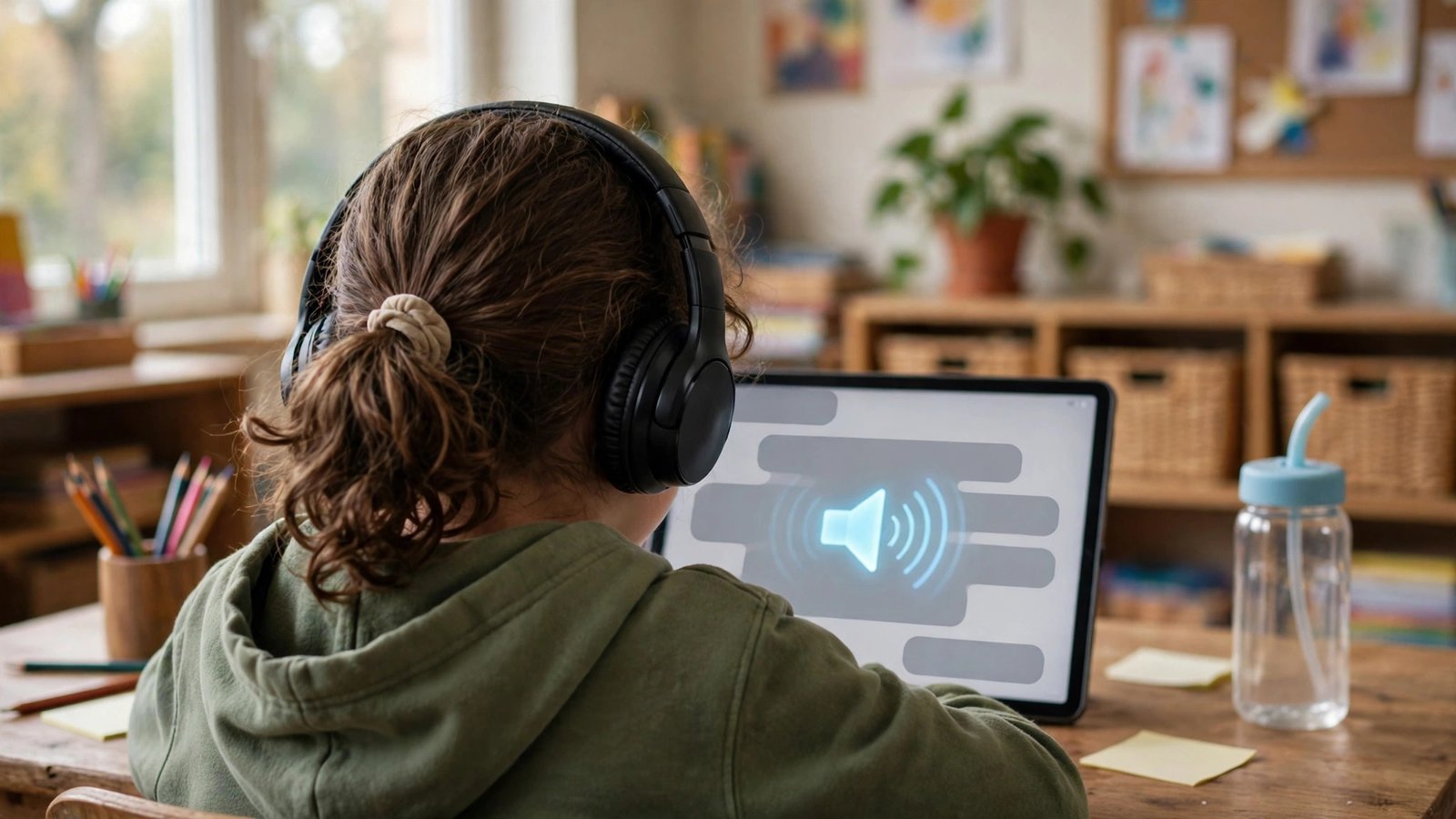
Working headphones are absolutely non-negotiable — thirty personal narrations at once is not an accommodation, it is a soundscape. Teach students the controls directly: play, pause, replay the sentence you zoned out on; the students who benefit most are the ones who learn to drive the tool strategically rather than letting it wash over them. Normalize the sight of it: when read-aloud is unremarkable — used by several students, for several reasons, including whole-class passages — the student whose plan requires it stops being a spectacle. And build the listening stamina honestly: a student new to text-to-speech needs practice sessions with it before a high-stakes sitting, because the skill of learning through the ear is itself learnable and itself takes time. Short passages first, questions replayed deliberately, then longer texts — the same progression you would use for any new reading strategy, because that is precisely what this is.
The official settings reference for all of this is the support library’s walkthrough of assigning a test in Pear Assessment, whose Test Behavior and Miscellaneous tabs hold the switches described here.
The case for class-wide read-aloud in the early grades
In kindergarten through about third grade, the whole-class scope deserves a stronger hearing than it usually gets. Decoding is still developing at wildly different rates in those rooms, which means any content test given in print is measuring reading development first and the content second — for every student, not just the ones with plans. Whole-class read-aloud on content assessments in those grades is not generosity; it is measurement hygiene. It tells you what your six-year-olds understand about life cycles, number sense, or community helpers, unpolluted by who cracked the code earliest.
The practice fades appropriately as grades rise and reading becomes the medium rather than the frontier — by upper elementary, print fluency is a fairer assumption and read-aloud narrows toward its accommodated, per-student role. Teachers in the transition years can run a hybrid: read directions and passages aloud to all, questions on request. However your room lands, decide it as a team, because students compare classrooms, and “Mrs. K reads everything, why doesn’t ours?” is a fair question with a better answer when the policy is deliberate.

When students refuse it, and when they lean too hard
Two human problems shadow every accommodation, and both are solvable. Refusal usually peaks in the middle school years, where being different in public can feel worse than struggling in private. The fixes are environmental, not argumentative: headphones make the support invisible; whole-class uses make it unremarkable; and a private conversation — “this is a tool your plan guarantees; let’s make it work your way” — respects the student’s dignity as a stakeholder rather than a case. Never force a spectacle; document offered-and-declined, coordinate with the case manager, and keep the door visibly open.
Over-reliance is the quieter worry: a student who lets the narration run without listening, or who could read the passage but has stopped trying. The answer is the same monitoring mindset you apply to any scaffold — periodic checks with the support faded in low-stakes practice tell you whether reading is growing underneath. Accommodations in good systems are reviewed against progress data at least annually; a student whose decoding has caught up may graduate from read-aloud with genuine cause for celebration, and that graduation is a success story the tool helped write, not a failure of it.
A start-of-term setup checklist
Thirty minutes in September prevents every October scramble. Collect the specifications: list every student whose plan names read-aloud or text-to-speech, with subjects covered. Configure the students once: set the accommodation at the student/account level your setup supports, not per assignment. Rehearse on real devices: one five-minute practice assignment with the support on, headsets distributed, controls taught. Agree the class-wide policy: which grades and assessment types get universal read-aloud, written down where the team can see it. Stage the fallbacks: spare headsets, a loaner device, and the coordinator-approved human-reader protocol. Calendar the review: one mid-year check that settings still match amended plans. Print it, tape it inside a cabinet, and next year’s setup takes ten.

FAQ
Does read-aloud read the questions too, or only passages?
The assign settings explicitly cover text-to-speech for passages, and accommodations configuration extends read-aloud support per your plan setup. Check your school’s configuration for the exact scope, and match it to what students’ plans and your state rules describe.
Can students control the playback themselves?
Yes — the design intent is student-driven play, pause, and replay, which is pedagogically the point: the student decides what to hear again, the way a reader’s eyes decide what to reread.
Is read-aloud cheating on a reading test?
It depends on the construct the test measures, which is why states and plans draw the line case by case. On a decoding assessment, read-aloud changes the construct; on a science test, it removes an irrelevant barrier. Mirror your state test’s rules so classroom scores predict accommodated performance honestly.
Does read-aloud help English learners too?
Often, yes — hearing text while seeing it supports vocabulary mapping and pronunciation models, and many EL frameworks list text-to-speech among recommended supports. Whether it is a designated support for a given student follows your district’s EL guidance and the student’s plans; where it is offered class-wide for content tests, English learners benefit incidentally and legitimately, one more argument for the universal scope in content areas where language load otherwise hides science and social studies knowledge.
What if a student’s device audio fails on test day?
Rehearse the fallback in advance: a spare headset, a loaner device, and — where the plan allows — a quiet-room human reader arrangement approved by your coordinator. Accommodation failures are logistics problems with known solutions, provided the solutions were staged before the morning they are needed.
Conclusion
Read aloud in Pear Assessment does one thing with outsized consequences: it lets the test hear the student’s knowledge instead of their decoding. Set the scope deliberately — whole class or per student — bind it faithfully to IEP and 504 specifications, rehearse it on real devices, and surround it with the other access levers on the assign screen. Do that, and “accommodated” stops meaning “handled awkwardly, at the last minute” and starts meaning what it was always supposed to: the same test, fairly reached — by every student in the room, through whatever channel their learning honestly requires.