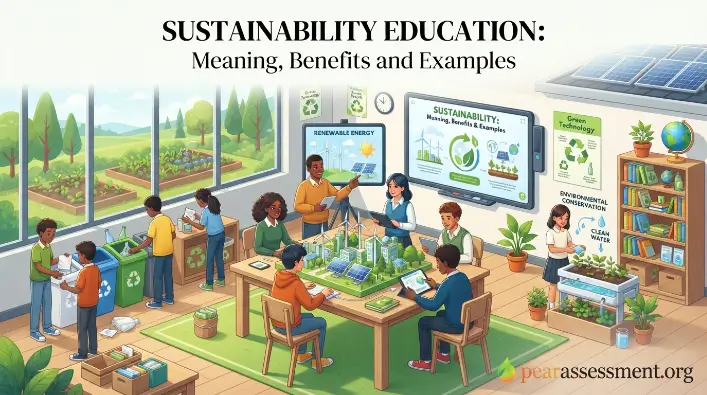
Welcome to Pear Assessment. Sustainability education helps students understand how their choices affect the environment, society, and the economy. It goes beyond teaching about climate change or recycling by developing the knowledge, skills, and values needed to make responsible decisions and contribute to a more sustainable future.
As environmental and social challenges continue to grow, sustainability education has become increasingly important in schools, universities, and communities. By connecting classroom learning with real-world issues, students can develop critical thinking, problem-solving skills, and practical habits that support sustainable development.
What Is Sustainability Education?
Sustainability education is a way of teaching people how their decisions and actions affect the environment, society, and the economy. It helps students understand major issues such as climate change, pollution, resource conservation, inequality, and responsible consumption. It is not limited to learning about the environment. Sustainability education also develops knowledge, critical-thinking skills, problem-solving abilities, responsible values, and practical habits that help people make better decisions for the present and future.
Sustainability Education vs. Environmental Education
Sustainability education and environmental education are closely related, but they are not the same. Environmental education mainly focuses on understanding the natural world and protecting it. Students may learn about climate change, pollution, biodiversity, ecosystems, conservation, and natural resources.
Sustainability education has a broader focus. It includes environmental issues but also considers social and economic factors. For example, students may study how poverty, access to education, responsible consumption, sustainable businesses, and environmental protection are connected.
- Explain the overlap.
- Show why sustainability includes social and economic considerations as well.
- Give a simple example.
Environmental education focuses mainly on protecting nature, while sustainability education takes a broader approach by connecting environmental, social, and economic well-being.
Read Also: What Education Is Needed to Become a Physical Therapist?
Why Is Sustainability Education Important?
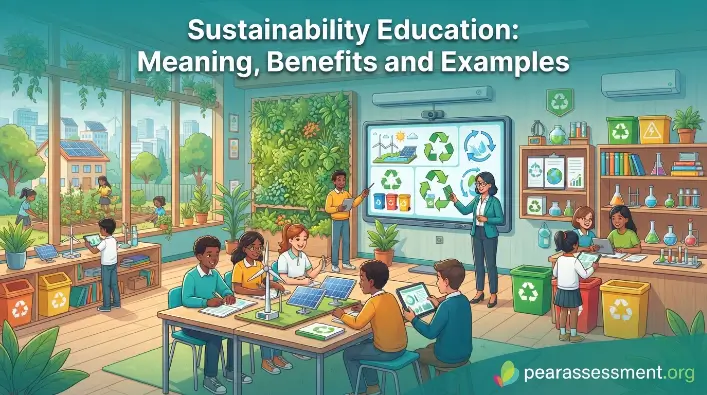
Sustainability education is important because it helps people understand the environmental, social, and economic challenges that affect our future. It teaches students how everyday choices such as using energy, consuming resources, managing waste, and treating others can have long-term effects. It also prepares students to become responsible and informed citizens. Instead of simply learning about problems such as climate change, pollution, or inequality, they learn how to think critically, evaluate possible solutions, and take practical action.
Building Sustainability Awareness
Sustainability awareness means understanding how our everyday actions affect the environment, society, and future generations. Sustainability education helps students recognize issues such as climate change, pollution, waste, water shortages, and the responsible use of natural resources.
For example, students can learn how wasting electricity or water affects the environment and why reducing waste can help conserve valuable resources. This awareness encourages them to think more carefully about their choices and their impact on others.
Developing Critical Thinking and Problem-Solving Skills
Sustainability education helps students develop critical thinking and problem-solving skills by encouraging them to look at real-world problems and think about possible solutions. Instead of simply memorizing facts, students learn to ask questions, examine information, compare different options, and understand the consequences of their decisions.
For example, students might investigate why their school produces too much waste and then discuss different ways to reduce it. They can compare solutions, consider their costs and benefits, and choose the most practical approach.
What Are the Main Dimensions of Sustainability Education?
Sustainability education looks at sustainability from different perspectives rather than focusing on only one issue. These dimensions help students understand how environmental concerns, people’s well-being, and economic decisions can influence one another. By learning about these connected areas, students can better understand real-world challenges and think about solutions that are practical, fair, and beneficial in the long term.
Environmental Sustainability
Environmental sustainability helps students understand how to protect natural resources and reduce harm to the environment. It encourages them to think about issues such as climate change, pollution, deforestation, biodiversity loss, water conservation, and waste management.
In education, students can explore practical ways to reduce environmental impact, such as saving water and electricity, reducing plastic use, recycling materials, protecting wildlife, and choosing more sustainable forms of transportation.
Cover:
- Climate change
- Biodiversity
- Pollution
- Waste management
- Water conservation
- Renewable energy
- Natural resource protection
The goal is to help students understand that natural resources are limited and that responsible choices today can help protect the environment for future generations.
Social Sustainability
Social sustainability focuses on people, communities, and their quality of life. In sustainability education, students learn how issues such as equality, inclusion, education, health, human rights, and community well-being are connected to creating a sustainable future.
For example, students may learn about equal access to education, respect for different backgrounds, community participation, and ways to create safe and inclusive environments. These lessons help them understand that sustainability is not only about protecting the planet but also about ensuring that people can live healthy, fair, and fulfilling lives
Cover:
- Equality
- Inclusion
- Health and well-being
- Human rights
- Community participation
- Cultural diversity
In terms of social sustainability encourages students to think about how their actions can support fairness, inclusion, and the well-being of others.
How Is Sustainability Education Taught?
Sustainability education is taught by connecting classroom learning with real-world environmental, social, and economic issues. Instead of teaching sustainability only as a separate subject, teachers can include it in different lessons and activities. For example, students may learn about climate change and ecosystems in science, natural resources in geography, responsible spending in economics, or equality and community development in social studies. This helps students understand that sustainability is connected to many parts of everyday life.
Integrating Sustainability Into the Curriculum
Integrating sustainability into the curriculum means including sustainability-related topics across different subjects instead of teaching them separately. This helps students understand that sustainability is connected to many areas of life and learning.
For example, science lessons can cover climate change, ecosystems, and renewable energy, while geography can focus on natural resources, water, and land use. Mathematics can use real data about energy consumption or waste, while economics can explore sustainable production and responsible consumption. Social studies can discuss equality, communities, and human rights.
Examples:
- Science: climate and ecosystems
- Geography: natural resources
- Mathematics: energy or waste data
- Economics: sustainable production
- Social studies: equality and communities
- Business: corporate sustainability
This approach makes sustainability more practical and relevant because students can see how the same idea applies to different subjects.
Project-Based and Experiential Learning
Project-based and experiential learning allows students to learn about sustainability by doing practical activities, rather than only reading about concepts in textbooks. It helps students connect classroom knowledge with real-world problems and possible solutions.
For example, students can organize a school recycling project, conduct an energy audit, plant trees, create a school garden, study water usage, or participate in a community cleanup. Through these activities, they can identify problems, work with others, test solutions, and observe the results of their actions.
Examples:
- School recycling project
- Tree-planting initiative
- School energy audit
- Water conservation project
- Community clean-up
- Sustainable food garden
This type of learning also develops important skills such as teamwork, communication, critical thinking, creativity, and problem-solving.
Benefits of Sustainability Education for Students
Sustainability education provides students with knowledge and practical skills that can help them make responsible decisions in everyday life. It encourages them to understand environmental and social challenges while thinking about how their actions can affect other people and future generations.
Use a concise table if appropriate:
| Benefit | What It Develops |
| Environmental awareness | Understanding ecological challenges |
| Critical thinking | Evaluating complex problems |
| Problem-solving | Finding practical solutions |
| Collaboration | Working on community projects |
| Responsible behavior | Making sustainable choices |
| Career readiness | Understanding emerging green careers |
| Civic engagement | Participating in community solutions |
Preparing Students for Future Careers
Sustainability education can help students prepare for careers in a world where organizations are paying more attention to environmental responsibility, resource efficiency, climate change, and sustainable development. Students can develop knowledge and skills that are useful across many industries, not only in environmental professions.
For example, sustainability knowledge can be valuable in fields such as renewable energy, engineering, agriculture, business, technology, construction, healthcare, education, and environmental management. Students may also develop skills such as problem-solving, teamwork, innovation, research, and responsible decision-making.
- Explain the growing relevance of sustainability across industries.
- Discuss green skills and sustainability-related careers.
- Emphasize that sustainability is not limited to environmental professions.
By introducing sustainability concepts early, education can help students understand emerging career opportunities and recognize how their future work can contribute to solving real-world challenges.
Practical Sustainability Education Activities and Examples
Practical sustainability education helps students turn what they learn in the classroom into real-world actions. Instead of only discussing environmental and social issues, students can participate in simple activities that show how sustainable choices work in everyday life. Schools and universities can choose activities based on students’ age, available resources, and local needs. These activities do not always require expensive equipment or large budgets.
Simple Classroom Activities
Teachers can introduce sustainability through simple classroom activities that do not require expensive materials or complicated planning. These activities help students understand sustainability concepts while encouraging them to think about how their everyday choices affect the environment and community.
For example, students can sort different types of waste, calculate how much paper or electricity their classroom uses, discuss ways to save water, or create posters about responsible consumption. Teachers can also organize short discussions about climate change, pollution, recycling, or renewable energy.
Waste-sorting exercise
- Sustainability quiz
- Energy-use calculation
- Water-use discussion
- Climate change case study
These simple activities can make sustainability lessons more engaging and help students develop responsible habits that they can use in their daily lives.
School or University Projects
Schools and universities can make sustainability education more practical by involving students in real projects that address problems on their campus or in the local community. These projects give students the chance to apply classroom knowledge while working toward measurable improvements.
For example, students can conduct a campus energy audit to identify unnecessary electricity use, organize a recycling campaign, create a water-saving plan, or develop a project to reduce food waste. They can also conduct surveys about sustainable transportation or create and maintain a school or university garden.
- Campus energy audit
- Tree plantation
- Recycling campaign
- Sustainable transport survey
- Food-waste reduction program
By participating in real sustainability projects, students can see how their ideas can create positive changes in their school, university, and wider community.
How to Make Sustainability Education More Effective
Sustainability education becomes more effective when students can connect what they learn with real-life situations. Simply teaching facts about climate change, pollution, or natural resources may not be enough. Students should also have opportunities to discuss problems, explore solutions, and take practical action. Teachers can make lessons more engaging by using local examples, group discussions, case studies, experiments, and hands-on projects.
Give a practical framework:
- Start with local issues.
- Connect lessons to everyday life.
- Use project-based learning.
- Encourage student participation.
- Integrate sustainability across subjects.
- Train teachers.
Students should not only memorize sustainability concepts; they should investigate a real problem, propose a solution, implement it where possible, and evaluate the result.
Frequently Asked Questions
What is sustainability education?
Sustainability education teaches students how environmental, social, and economic issues are connected. It helps them develop the knowledge, skills, and values needed to make responsible decisions and contribute to a more sustainable future.
Why is sustainability education important?
It helps students understand important challenges such as climate change, pollution, resource use, and social inequality. It also develops critical thinking, problem-solving, responsible decision-making, and practical skills that can help students respond to future challenges.
What are the three main dimensions of sustainability?
The three main dimensions are environmental, social, and economic sustainability. Environmental sustainability focuses on protecting natural resources, social sustainability focuses on people’s well-being and equality, and economic sustainability focuses on responsible resource use and long-term economic stability.
How can schools teach sustainability?
Schools can teach sustainability by integrating it into different subjects and using projects, outdoor learning, classroom activities, and hands-on experiences. Schools can also involve students in recycling programs, energy-saving initiatives, school gardens, water conservation projects, and community activities.
Is sustainability education the same as environmental education?
No. Environmental education mainly focuses on understanding and protecting the natural environment, while sustainability education has a broader focus. It includes environmental issues as well as social and economic concerns. Environmental education is therefore an important part of sustainability education, but it does not cover the entire concept.
Conclusion
Sustainability education helps students understand how environmental, social, and economic issues are connected to everyday life. Through classroom lessons, practical projects, and real-world activities, students can develop critical thinking, problem-solving skills, and responsible habits.
By making sustainability part of education, schools and universities can prepare students to make informed decisions and contribute to a healthier and more sustainable future. Sustainability education is not just about learning; it is about turning knowledge into meaningful action.