
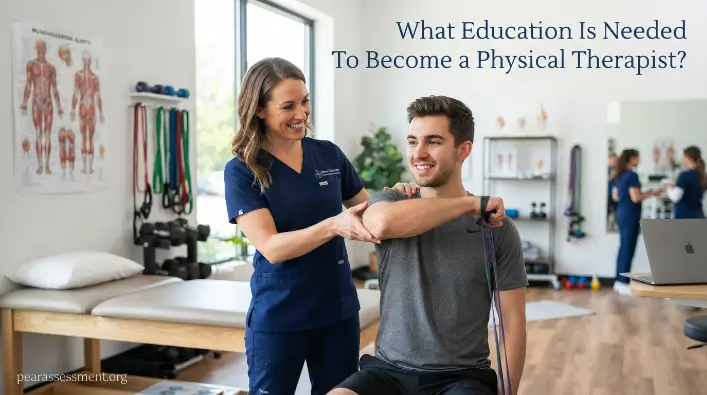
Welcome to Pear Assessment. Becoming a physical therapist requires several stages of education and professional training. In the United States, students typically complete undergraduate education, meet physical therapy school prerequisites, earn a Doctor of Physical Therapy (DPT) degree, complete clinical education, and meet state licensing requirements.
If you are planning this career, understanding the education pathway can help you choose the right major, complete the required courses, and prepare for DPT school. This guide explains what education is needed to become a physical therapist and what you can expect at each stage.
What Education Do You Need to Become a Physical Therapist?
In the United States, becoming a physical therapist requires several stages of education and professional training. You do not usually become a physical therapist immediately after high school. Instead, students typically complete undergraduate education first, followed by a Doctor of Physical Therapy (DPT) program. During college, students also need to complete specific prerequisite courses required by the DPT programs they want to apply to. These may include subjects such as anatomy, physiology, biology, chemistry, physics, psychology, and statistics. The exact requirements can vary between universities.
Bachelor’s Degree or Undergraduate Education
Most students complete a bachelor’s degree before entering a DPT program. Your undergraduate major does not always have to be physical therapy-related, but it should allow you to complete the prerequisite courses required by the DPT programs you plan to apply to.
Common undergraduate majors include kinesiology, exercise science, biology, health sciences, and psychology. Choosing a major that matches your interests while allowing you to complete the required prerequisites can make your preparation easier.
Doctor of Physical Therapy (DPT) Degree
The Doctor of Physical Therapy is the professional degree required for entry-level physical therapist practice in the United States. DPT programs combine classroom education, laboratory learning, and clinical experience.
A typical DPT program takes about three years after undergraduate education, although program structures can vary.
What Do You Study Before Physical Therapy School?
Before applying to physical therapy school, students usually need to complete certain prerequisite courses during their undergraduate education. These courses help students build a strong foundation in the sciences and other subjects they will study in a Doctor of Physical Therapy (DPT) program. The exact courses required can vary from one DPT school to another. For example, one university may require a specific number of biology or chemistry courses, while another may have additional requirements for psychology or statistics.
Common Physical Therapy Prerequisite Courses
Before applying to a DPT program, students usually complete several important college courses that prepare them for advanced physical therapy education. These courses build the academic foundation needed to understand the human body, movement, and rehabilitation.
The most common prerequisites include anatomy, physiology, biology, chemistry, physics, psychology, and statistics. However, the exact combination can vary between universities, so students should check the requirements of each DPT program before planning their coursework.
Common prerequisites may include:
- Anatomy
- Physiology
- Biology
- Chemistry
- Physics
- Psychology
Some programs may have additional requirements or specific course expectations. For this reason, students should review DPT admission requirements early during their undergraduate education.
What Undergraduate Major Should You Choose?
There is not necessarily one required undergraduate major for every future physical therapist. Kinesiology, exercise science, biology, health sciences, and psychology are common choices.
The most important consideration is whether your major allows you to complete the prerequisites required by your target DPT programs while maintaining strong academic performance.
Read Also: Board of Education: Roles, Duties, and How It Works
What Do You Learn in a Doctor of Physical Therapy Program?

A Doctor of Physical Therapy (DPT) program combines classroom education, laboratory practice, and clinical training to prepare students for professional physical therapy practice. Students learn how to assess patients, understand movement and physical function, identify problems, and develop appropriate treatment plans. Throughout the program, students study both the science behind the human body and the practical skills used in patient care. They gradually move from learning concepts in the classroom to applying those skills in hands-on settings.
Core Physical Therapy Subjects
During a DPT program, students study a range of subjects that build their knowledge of the human body, movement, injuries, and rehabilitation. These subjects help students develop the academic and practical knowledge needed to assess patients and plan appropriate treatment.
The curriculum commonly includes anatomy, physiology, biomechanics, neuroscience, pharmacology, therapeutic exercise, rehabilitation, and patient assessment. Students learn how these areas connect to physical therapy and how to apply their knowledge when working with different types of patients.
DPT students may study subjects such as:
- Anatomy
- Physiology
- Biomechanics
- Neuroscience
- Pharmacology
- Therapeutic exercise
- Rehabilitation
- Patient assessment
These subjects help students understand how the human body works and how injuries, illnesses, and movement problems can affect physical function.
Clinical Education and Hands-On Training
Clinical education is an important part of physical therapy training. Students gain supervised experience working with patients and applying the knowledge and skills learned in the classroom.
Clinical experiences may take place in hospitals, outpatient clinics, rehabilitation facilities, and other healthcare settings. This hands-on training helps students develop patient-care, communication, assessment, and treatment skills.
How Long Does It Take to Become a Physical Therapist?
In the United States, becoming a physical therapist typically takes about seven years of education. Most students spend around four years completing a bachelor’s degree and then about three years completing a Doctor of Physical Therapy (DPT) program. The timeline can be different for some students. It may take longer if prerequisite courses are not completed on time, if a student takes a different undergraduate path, or if the selected DPT program has different requirements.
Typical Education Timeline
For most students in the United States, the education pathway to becoming a physical therapist takes around seven years. The first stage is usually a four-year bachelor’s degree, during which students complete their general education and required physical therapy prerequisites.
After completing undergraduate education, students typically spend about three years in a Doctor of Physical Therapy (DPT) program. During this time, they complete classroom study, laboratory work, and clinical education. After graduation, they must complete the required licensing process before practicing as a physical therapist.
| Stage | Typical Time |
| Bachelor’s degree | About 4 years |
| DPT program | About 3 years |
| Total | About 7 years |
This timeline does not necessarily include additional time a student may spend completing prerequisites, gaining experience, or pursuing optional specialty training.
Can You Become a Physical Therapist Without a DPT?
In the United States, you generally cannot become a licensed physical therapist with only a bachelor’s degree, certificate, or short-term training program. The standard pathway requires completing an accredited Doctor of Physical Therapy (DPT) program and then meeting the licensing requirements in the state where you want to practice.
It is also important to understand the difference between a physical therapist (PT) and a physical therapist assistant (PTA). A PTA follows a different educational pathway and works under the direction and supervision of a physical therapist. So, if your goal is to become a licensed physical therapist, a DPT is an essential part of the education pathway.
What Happens After You Earn a DPT?
This usually means applying for a physical therapist license and meeting the required examination and other state-specific requirements. Once licensed, graduates can begin working as physical therapists in settings such as hospitals, outpatient clinics, rehabilitation centers, and other healthcare facilities. Some graduates may also choose to continue their education through a clinical residency or specialty training to develop advanced skills in a specific area of physical therapy.
Complete the Licensing Requirements
After completing a DPT program, graduates must obtain a physical therapist license before they can legally practice in the United States. The licensing process is handled by individual states, so the exact requirements may differ depending on where you plan to work.
Graduates should check their state’s licensing board to find out what documents, applications, examinations, fees, and other requirements they need to complete. Meeting these requirements ensures that the graduate is officially qualified to provide physical therapy services to patients.
Pass the Physical Therapy Licensing Exam
After completing a DPT program, graduates generally need to pass the National Physical Therapy Examination (NPTE) as part of the licensing process. The exam tests the knowledge and skills needed to practice safely and effectively as a physical therapist.
Students should start preparing for the NPTE before graduation and review the specific licensing requirements of the state where they plan to work. Once they meet the required conditions and pass the exam, they can move forward with obtaining their physical therapist license.
Consider a Residency or Specialty Training
Residency training is an optional way to gain additional clinical experience and develop expertise in a particular area of physical therapy.
Clinical residencies typically provide focused training after the DPT and can help physical therapists develop advanced skills in a specialty area.
Common Mistakes Students Make When Preparing for Physical Therapy School
Preparing for DPT school involves careful planning, and small mistakes can create problems during the application process. Students may choose a major without checking prerequisite courses, overlook specific admission requirements, or focus only on grades without developing other important skills and experience. It is also important to research each DPT program carefully instead of assuming that all schools have the same requirements.
Choosing a Major Without Checking Prerequisites
Choosing a major simply because it seems related to physical therapy can lead to problems later. A student may complete a degree in kinesiology, exercise science, biology, or another related field but still discover that some DPT programs require courses they have not taken.
Before choosing your undergraduate courses, review the prerequisite requirements of the DPT programs you are interested in. Then plan your schedule so you can complete the required subjects along with your degree. This can help you avoid taking extra courses or delaying your application to physical therapy school.
Assuming Every DPT Program Has the Same Requirements
Not every Doctor of Physical Therapy program has the same admission requirements. One university may require certain prerequisite courses, grades, observation hours, or application materials that another program does not require.
If you plan to apply to multiple DPT programs, review the requirements for each university separately. Check the official program website for the most current information and make a list of the requirements you need to complete. This helps you avoid missing an important requirement when submitting your application.
Focusing Only on Grades
Good grades are important when preparing for DPT school, but academic performance is not the only part of becoming a successful physical therapist. Students should also develop strong communication skills because physical therapists work closely with patients and need to explain exercises, treatments, and recovery plans clearly.
It can also be helpful to gain relevant experience and learn more about the day-to-day responsibilities of physical therapists. Understanding the profession before applying to DPT school can help you decide whether physical therapy is the right career for you and prepare you for working directly with patients.
Physical Therapist Education vs. Physical Therapist Assistant Education
Physical therapists (PTs) and physical therapist assistants (PTAs) both work in rehabilitation and help patients improve their movement and physical function, but their education and responsibilities are different. A physical therapist completes a Doctor of Physical Therapy (DPT) program and is trained to evaluate patients, develop treatment plans, and provide physical therapy services.
| Factor | Physical Therapist | Physical Therapist Assistant |
| Professional education | DPT | Associate-level PTA education |
| Role | Evaluates and treats patients | Provides care under PT direction/supervision |
| Education length | Longer | Shorter |
| Career level | Physical therapist | Physical therapist assistant |
A physical therapist completes professional doctoral-level education, while a physical therapist assistant follows a different educational pathway and works under the direction and supervision of a physical therapist.
Is a Career in Physical Therapy Right for You?
Education is only one part of preparing for a physical therapy career. It is also important to consider whether the work matches your interests, strengths, and career goals. Physical therapy may be a good fit for someone who enjoys anatomy, human movement, problem-solving, and helping people recover from injuries or physical conditions. Communication and patience are also important because physical therapists work directly with patients and often help them understand and follow rehabilitation plans.
The general U.S. pathway can be summarized in these steps:
- Complete high school prerequisites.
- Earn an undergraduate degree.
- Complete the required DPT prerequisites.
- Gain relevant experience where appropriate.
- Apply to accredited DPT programs.
Following these steps can help students understand what they need to accomplish from undergraduate education through professional practice.
Frequently Asked Questions
What degree do you need to become a physical therapist?
In the United States, the professional degree for entry-level physical therapist practice is generally the Doctor of Physical Therapy (DPT). Students typically complete undergraduate education and the required prerequisites before entering a DPT program.
Do you need a bachelor’s degree to become a physical therapist?
The typical U.S. pathway involves completing undergraduate education before entering a DPT program. The exact undergraduate requirements can vary between DPT programs, so students should check the admission requirements of the schools they plan to attend.
What should I major in to become a physical therapist?
Common undergraduate majors include kinesiology, exercise science, biology, health sciences, and psychology. There is not necessarily one required major for every DPT program. The important thing is to complete the prerequisites required by your target schools.
How many years does it take to become a physical therapist?
A typical U.S. pathway takes about seven years: approximately four years of undergraduate education followed by about three years in a DPT program. The exact timeline can vary depending on the student’s educational path.
Is a DPT the same as a physical therapy certification?
No. A DPT is a professional doctoral degree that prepares students for physical therapist practice. It is different from a short certification program and forms part of the educational pathway toward professional licensure.
Conclusion
Knowing what education is needed to become a physical therapist can help you plan your career from the beginning. In the United States, the typical pathway includes undergraduate education, prerequisite courses, a Doctor of Physical Therapy degree, clinical education, and state licensing requirements.
Choosing the right undergraduate major, checking DPT prerequisites early, selecting an accredited program, and preparing for clinical training can make the process more manageable. With the right education and professional preparation, you can move from undergraduate study toward a career as a physical therapist.