
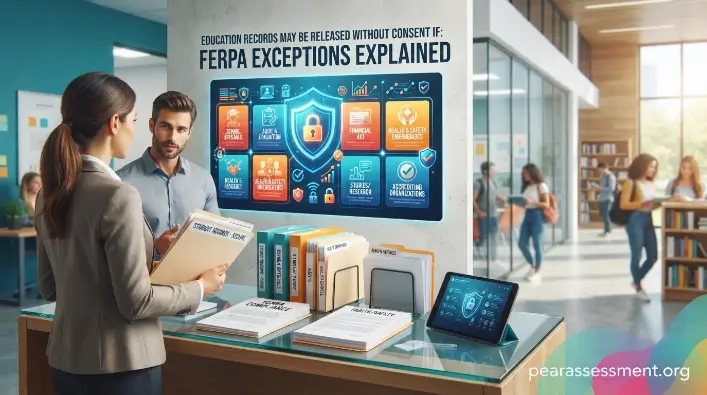
Welcome to Pear Assessment. Education records may be released without consent if a specific exception under the Family Educational Rights and Privacy Act (FERPA) applies. FERPA generally protects student education records and requires written consent before personally identifiable information is disclosed. However, the law allows schools to share records in certain situations without getting consent first.
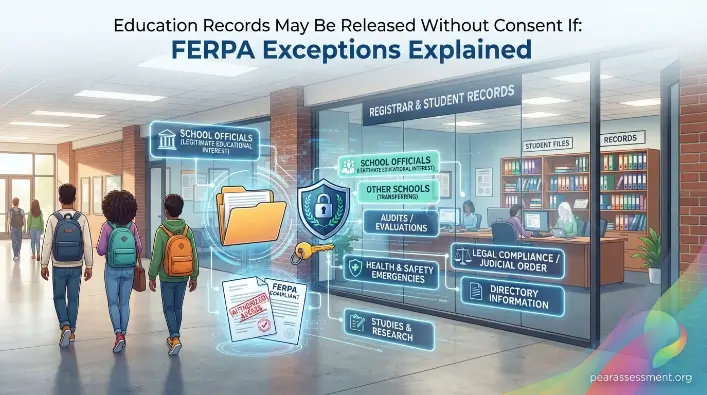
These exceptions can apply when a school official has a legitimate educational interest, when a student transfers to another school, when a valid court order or subpoena exists, or during a qualifying health or safety emergency. Other exceptions cover directory information, financial aid, studies, audits, and certain legal situations.
When Can Education Records Be Released Without Consent?
FERPA generally requires a school to obtain consent before disclosing a student’s education records or personally identifiable information (PII). However, the law provides specific exceptions that allow a school to disclose records without consent in certain situations. For example, disclosure may be allowed for a legitimate educational interest, a student transferring to another school, a qualifying legal order, or a health or safety emergency. It is important to remember that a FERPA exception generally means the school may disclose the information; it does not always mean the school must disclose it.
The General FERPA Rule for Student Records
The basic FERPA rule is that schools generally need prior written consent before releasing personally identifiable information from a student’s education records. Valid consent should identify the records being disclosed, explain the purpose of the disclosure, and identify the person or organization receiving the information. It must generally be signed and dated by the parent or eligible student.
FERPA rights generally belong to the parent until they transfer to the student when the student becomes an eligible student, such as when the student reaches the applicable age or attends a postsecondary institution. After that point, the eligible student generally controls the FERPA rights related to their education records.
What “Without Consent” Actually Means
“Without consent” does not mean a school has unlimited permission to share student information. It means that the disclosure qualifies for a specific FERPA exception, so the school does not need to obtain written consent beforehand. The school should identify the applicable exception and make sure its requirements are satisfied before releasing the information.
For example, a teacher or other qualifying school official may access records when there is a legitimate educational interest. Likewise, a school may disclose appropriate records to another school when a student seeks or intends to enroll there, provided the FERPA requirements for that disclosure are met.
Common FERPA Exceptions That Allow Disclosure Without Consent
Education records may be released without consent if a specific FERPA exception applies and its requirements are satisfied. The main exceptions cover educational needs, school transfers, legal processes, emergencies, financial aid, research, program evaluation, and certain types of information.
| FERPA exception | When disclosure may be allowed |
| School officials | For a legitimate educational interest |
| Another school | When the student seeks or intends to enroll |
| Court order or subpoena | When FERPA’s legal requirements are met |
| Health or safety emergency | To protect someone’s health or safety during a qualifying emergency |
| Financial aid | For specific financial-aid purposes |
| Studies | For qualifying educational research |
| Audits or evaluations | For authorized program reviews |
| Directory information | When required notice and opt-out rules are followed |
| Juvenile justice matters | When specific legal requirements apply |
These exceptions allow schools to handle necessary educational and legal matters while still protecting student privacy. A school should always identify the specific exception before disclosing because each exception has its own conditions.
School Officials With a Legitimate Educational Interest
FERPA may allow school officials to access education records when they have a legitimate educational interest in the information. This can include a teacher who needs relevant student information to provide instruction or an administrator who needs records to perform an assigned responsibility.
However, this exception does not give every school employee unlimited access to student records. Schools should determine which officials have a legitimate educational interest and limit access to information needed for their professional responsibilities.
Another School Where the Student Plans to Enroll
A school may disclose appropriate student records to another school when the student seeks or intends to enroll there, as long as the applicable FERPA requirements are met. This can make it easier to transfer necessary academic information when a student changes schools or moves to another educational program.
The exception supports a smooth transition between educational institutions without requiring a separate consent process for every qualifying transfer. The receiving school should still receive and use the information according to applicable privacy requirements.
Court Orders and Lawfully Issued Subpoenas
FERPA can permit disclosure without consent when a valid court order or lawfully issued subpoena meets the applicable requirements. Before releasing records, the school should review the legal document carefully and determine what information the order or subpoena covers.
A legal request does not automatically mean that every student record can be released. The school must follow the specific FERPA requirements connected to the legal process and disclose only what the applicable order or subpoena permits or requires.
Health or Safety Emergencies
FERPA allows certain disclosures during a health or safety emergency when the information is necessary to protect the health or safety of the student or another person. The situation must involve an actual, impending, or imminent threat that meets FERPA’s emergency requirements.
This exception is not a general reason to share student information whenever it may be helpful. Schools should determine whether a qualifying emergency exists and follow the applicable documentation requirements for the disclosure.
Financial Aid, Studies, Audits, and Other Exceptions
FERPA also permits certain disclosures for financial aid, educational studies, audits, and evaluations. For example, information may be disclosed when it is needed to determine financial-aid eligibility, amount, or conditions. Qualifying educational studies and authorized program audits may also fall within specific FERPA exceptions.
These exceptions are subject to specific conditions, so schools should not rely only on the general category. Before releasing information, they should confirm that the purpose, recipient, and circumstances meet the requirements of the particular FERPA exception.
Read Also: Panorama Education: Complete Guide to Surveys, Student Success & MTSS
Can Directory Information Be Released Without Consent?
Yes, schools may generally disclose properly designated directory information without obtaining individual consent, but only after meeting FERPA’s notice and opt-out requirements. Directory information is limited to specific categories identified by the school, so it does not mean that a student’s entire education record is available to the public.
What Counts as Directory Information?
Directory information may include basic student details that a school has officially designated for this purpose. Common examples include:
- Student name
- Address and telephone number
- Email address
- Dates of attendance
- Grade level
- Participation in officially recognized activities
- Awards and honors
Schools determine which categories they designate as directory information, within the limits of FERPA. The exact categories can therefore vary between educational institutions.
Why Schools Must Give an Opt-Out Opportunity
Before disclosing designated directory information, a school generally must provide parents or eligible students with proper notice about the information it considers directory information. The notice must also explain the right to opt out of disclosure.
This means a school cannot simply decide that any student information is public. Its directory information policy must be established in advance and must follow FERPA’s applicable requirements.
Why Directory Information Is Different From Grades and GPA
Directory information is treated differently from sensitive academic information. A student’s name or grade level may qualify as directory information, but grades, test scores, and similar academic details generally receive FERPA protection and cannot be disclosed simply because some basic student information is considered directory information.
In other words, permission to disclose one category of directory information does not give a school permission to release the student’s complete education record. Each type of information must be evaluated under the applicable FERPA rules.
What Information Is Not Protected as an “Education Record” Under FERPA?
Not every record maintained by a school qualifies as an education record under FERPA. This distinction matters because FERPA’s disclosure rules generally apply only to records that meet the legal definition of education records. Before applying a FERPA exception, a school should first determine whether the information is actually covered by the law.
Common Records Excluded From FERPA’s Definition
Certain types of records may fall outside FERPA’s definition of education records, including:
- Certain sole-possession records kept as personal memory aids
- Certain law-enforcement-unit records
- Certain employment records
- Certain treatment records
- Certain post-attendance records
- Certain peer-graded papers before they are collected and recorded
These exclusions have specific requirements, so a record should not be classified simply by its title. Schools should consider how the record is created, maintained, and used when determining whether FERPA applies.
Why This Distinction Matters
If information does not qualify as an education record, FERPA’s education-record disclosure restrictions may not apply to it. However, this does not automatically make the information public or freely shareable.
Other federal or state privacy laws, school policies, contracts, or confidentiality duties may still protect the information. Therefore, schools should check all applicable privacy requirements before releasing records, even when FERPA does not apply.
What Schools Should Check Before Releasing Student Records
Before releasing education records, schools should use a consistent review process.
A simple checklist can help:
- Is the information an education record?
First determine whether FERPA applies to the record. - Does it contain personally identifiable information?
Identify whether the information can directly or indirectly identify the student. - Is written consent required?
If no exception applies, obtain valid written consent. - Does a FERPA exception apply?
Identify the exact exception instead of relying on a general assumption. - Is the recipient authorized?
Confirm that the person or organization receiving the information qualifies under the applicable exception. - Is the disclosure limited appropriately?
Share information consistent with the applicable FERPA requirements and purpose. - Does the disclosure need to be documented?
FERPA generally requires schools to maintain records of certain requests for access and disclosures, subject to specified exceptions.
This process reduces accidental FERPA violations and helps schools demonstrate that their disclosures were properly considered.
Common Mistakes About FERPA Disclosure Rules
Understanding FERPA disclosure rules means knowing not only when records can be shared, but also when they should not be shared. Common mistakes include assuming every employee has access, treating emergencies as unlimited exceptions, confusing directory information with public records, and assuming that a permitted disclosure is always required. Avoiding these mistakes helps schools protect student privacy and apply FERPA exceptions correctly.
Mistake 1: Assuming Every School Employee Can See Records
A common mistake is believing that anyone working for a school can access student records. Under FERPA, access for a school official is generally connected to a legitimate educational interest. For example, a teacher may need specific information to support instruction, while an employee with no educational reason should not access the same record.
Schools should therefore use role-based access and provide employees only the information needed for their assigned responsibilities. Simply being a teacher, administrator, contractor, or other school employee does not automatically create a right to view every student’s education record.
Mistake 2: Treating an Emergency Exception as Unlimited Permission
The health or safety emergency exception is limited to situations that meet FERPA’s emergency requirements. A school may disclose information when it is necessary to protect the health or safety of a student or another person during an actual, impending, or imminent emergency.
Schools should not use this exception simply because sharing information seems convenient or potentially helpful. They should first determine whether a qualifying emergency exists, why the disclosure is necessary, and what information is appropriate to disclose.
Mistake 3: Assuming Directory Information Means Everything Is Public
Directory information only includes the categories a school has officially designated under its FERPA policy. Before disclosure, the school generally must provide the required notice and allow parents or eligible students to opt out.
This means a student’s name being listed as directory information does not make the student’s entire record public. Grades, test scores, disciplinary information, and other protected academic details must still be handled according to the applicable FERPA rules.
Mistake 4: Assuming FERPA Requires Every Permitted Disclosure
Another important mistake is confusing a permitted disclosure with a required disclosure. When a FERPA exception applies, the school may be legally allowed to release information without consent, but the exception does not necessarily require the school to make that disclosure.
Before releasing records, the school should consider the exact FERPA exception, the purpose of the request, applicable federal or state law, and its own privacy policies. This helps ensure that a disclosure is both legally permitted and appropriate under the circumstances.
Quick Answer: Education Records May Be Released Without Consent If…
Education records may be released without consent if a FERPA exception permits the disclosure.
Common examples include:
- A qualifying school official has a legitimate educational interest.
- The student seeks or intends to enroll at another school.
- A valid court order or lawfully issued subpoena permits disclosure.
- A qualifying health or safety emergency exists.
- The disclosure is needed for certain financial aid purposes.
- The records are needed for qualifying educational studies.
- The information is needed for certain audits or evaluations.
- The information qualifies as properly designated directory information and FERPA’s notice and opt-out requirements have been satisfied.
- Another specific FERPA exception applies.
The important point is that each exception has conditions. Schools should identify the exact exception before releasing student education records.
Frequently Asked Questions
Does FERPA apply to all student information held by a school?
No. FERPA generally applies to records that meet its definition of education records. Certain records, such as specific law-enforcement or treatment records, may fall outside that definition.
Can parents always access their child’s education records?
Generally, FERPA gives parents rights to inspect and review their child’s education records, but those rights can transfer to the student when the student becomes an eligible student.
Can a school share student records with a third-party service provider?
Yes, in certain circumstances. A qualifying third-party provider may receive records when it performs an institutional function and meets FERPA’s applicable requirements for protecting the information.
Does FERPA prevent schools from using student information for research?
Not necessarily. FERPA allows certain disclosures for educational studies when the research purpose and other legal requirements are satisfied, including requirements designed to protect student information.
What should a school do if it is unsure whether disclosure is allowed?
The school should identify the type of record, determine whether FERPA applies, and check whether a specific disclosure exception covers the situation before releasing the information.
Conclusion
FERPA disclosure rules can seem complicated, but the basic idea is simple: student education records should be kept private unless a valid reason allows their release. Education records may be released without consent if a specific FERPA exception applies. These exceptions can cover school officials, student transfers, legal requests, qualifying emergencies, financial aid, research, audits, and properly designated directory information. Each exception has its own conditions, so schools should check the specific rule before sharing any student information.
Protecting student privacy requires more than simply asking whether disclosure is allowed. Schools should also consider what information is being shared, who will receive it, and why it is needed. A permitted disclosure does not always mean that disclosure is required. By following FERPA carefully and limiting information to appropriate purposes, schools can support students while protecting their educational records and privacy.