

Some exit ticket formats become classics because they work everywhere with zero setup. The exit ticket 3 2 1 is the most famous: three of one thing, two of another, one of a third — a counting frame that turns “write something about today” into a structured, sortable response. This guide explains what the 3-2-1 exit ticket is, gives you the free template structure teachers actually use, and then adapts the idea by subject — poetry, math topics like volume, bar graphs, and perimeter, and ELA — so you can run it tomorrow in whatever you teach. It builds on our general guide to the exit ticket, so start there if the routine itself is new.
what is a 3 2 1 exit ticket
A 3-2-1 exit ticket is a closing prompt with three numbered responses of decreasing quantity. The classic classroom version asks for 3 things you learned, 2 questions you still have (or examples you can give), and 1 thing you found interesting, confusing, or want to learn more about. Variants swap the categories: 3 key ideas, 2 connections to earlier learning, 1 prediction about tomorrow; or for skills lessons, 3 steps of the process, 2 common mistakes, 1 worked example.
The countdown structure does three jobs at once. It guarantees every student produces something at each level — recall, connection, reflection — instead of stopping at the first easy sentence. It self-differentiates: the “3” items sample breadth, while the single “1” item (usually the question or the confusion) reveals depth and honesty. And it sorts beautifully: teachers scan the “1” column down a class set in under two minutes and know exactly what tomorrow’s opener must address. Few formats return this much signal per minute of class time.

3 2 1 exit ticket template free
Here is the free 3-2-1 exit ticket template most teachers print or project — copy it as-is:
Name: __________ Date: ______ Class: ______
3 — Three things I learned today: 1) ___ 2) ___ 3) ___
2 — Two questions I still have: 1) ___ 2) ___
1 — One thing I will remember (or: one thing still muddy for me): ___
Design notes from teachers who use it daily: print four templates per page and cut them apart to save paper, or project the frame and let students write on notebook paper or a digital form. Keep the categories stable for at least a month — students get faster and more honest when the frame is predictable — then rotate one category at a time (swap “questions I still have” for “connections I can make”) to refresh it. For younger students, use pictures or sentence starters in each row; for older students, raise the bar on the “1” row, which is where the diagnostic gold lives. Teachers who differentiate by readiness will also find the tiered versions in our guide to differentiated exit tickets pair naturally with this template.
Accessibility tweaks keep the whole class inside the routine. Offer a word bank for the “3 things I learned” row so English learners and struggling writers spend their effort on ideas, not spelling retrieval. Allow drawing for one of the rows in elementary grades. And for students with writing accommodations, a recorded 30-second audio 3-2-1 preserves the thinking while removing the barrier — the frame matters, not the medium.
poetry exit tickets
Poetry exit tickets solve a real problem: poetry lessons produce strong feelings and vague evidence. A 3-2-1 frame tightens both. 3 — three images or phrases from today’s poem that struck you, copied exactly. 2 — two things the poet’s word choices do (the effect, not just the device name). 1 — one question the poem leaves you with, or one line you would write next if the poem continued.
Other poetry-ready prompts: “Name the device in line ___ and explain its effect in one sentence.” “Rewrite the poem’s saddest (or happiest) line in plain language — what is lost in translation?” “Give the poem a new title and defend it in one sentence.” Each takes under four minutes, and each forces contact with the actual text rather than a general impression — the difference between “the poem was sad” and evidence a teacher can teach from tomorrow.

volume exit ticket
A volume exit ticket targets the day’s specific skill — measuring the space inside a three-dimensional figure — instead of generic reflection. Strong versions for a lesson on rectangular prisms:
- “Find the volume of a box 4 cm × 3 cm × 5 cm. Show the formula and your steps.”
- “Two boxes have the same volume. Box A is 2 × 4 × 6. Give possible dimensions for Box B.”
- “Marta says the volume of a 3 × 3 × 3 cube is 9 because 3 × 3 = 9. What is her mistake?”
- 3-2-1 version: 3 — three units volume can be measured in; 2 — two real objects whose volume you’d want to know and why; 1 — one step of the formula you want more practice with.
The misconception item is the highest-value question on the list: volume errors are usually conceptual (confusing area and volume, adding instead of multiplying dimensions), and a ticket that surfaces them tonight saves a reteach after the quiz.
bar graph exit ticket
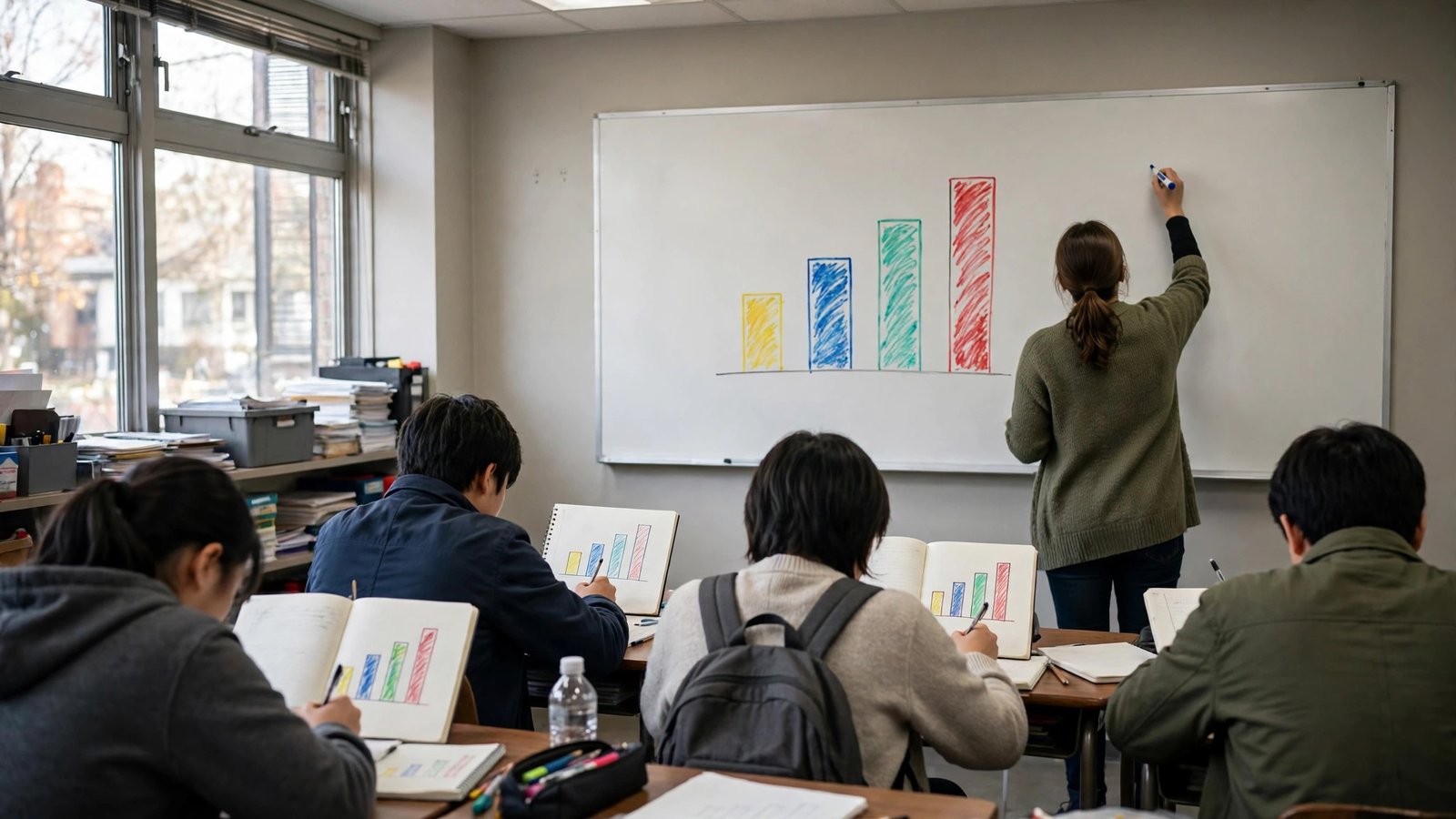
A bar graph exit ticket checks data-display understanding the day it’s taught:
- Show a simple bar graph (pets owned by a class). “How many more students own dogs than cats? How do you know?”
- “The bars for Monday and Tuesday look almost the same height. What question should you ask before concluding anything?” (Answer target: the scale and intervals.)
- Give raw data — “apples sold: Mon 4, Tue 7, Wed 5” — and have students sketch the bar graph with labeled axes.
- 3-2-1 version: 3 — three things a bar graph must have to be complete (title, labels, scale); 2 — two comparisons this graph lets you make; 1 — one question this graph cannot answer.
That last item is quietly brilliant for data literacy: students learn that graphs answer some questions and not others, which is the seed of every later statistics conversation.
perimeter exit ticket
A perimeter exit ticket works the same way for the distance-around-a-shape lesson:
- “Find the perimeter of a rectangle 8 m by 5 m. Show your method.”
- “A square has a perimeter of 20 cm. How long is each side? Explain.”
- “Jayden added only two sides of the rectangle ‘because the other two are the same.’ When does that shortcut work, and when does it fail?”
- 3-2-1 version: 3 — three real things you might measure the perimeter of; 2 — two ways to find a rectangle’s perimeter; 1 — one way perimeter differs from area.
The perimeter/area contrast item is essential: confusing the two is the single most common error in this unit, and a ticket that asks students to state the difference in their own words tonight tells you whether tomorrow’s area lesson has a foundation or a fault line.

ela exit tickets
ELA exit tickets lean on text evidence and craft. Reliable frames beyond the poetry versions above:
- Main idea sprint: “The main idea of today’s chapter in 12 words or fewer — then the sentence that proves it.”
- Character evidence: “One thing [character] did today, and what it reveals. Quote the line.”
- Craft move: “Find one sentence where the author slows down time. What words do the work?”
- Grammar in context: “Write one sentence about today’s reading using a semicolon correctly.”
- 3-2-1 for a novel study: 3 events in order; 2 predictions with reasons; 1 question for the author.
The word-limit trick (12 words or fewer) deserves emphasis: compression forces selection, and selection is exactly the thinking ELA teachers want to see. More subject prompts live in our master list of exit ticket examples.
types of exit tickets
Stepping back, the types of exit tickets you’ve met in this guide form a tidy taxonomy. Content checks verify the objective (the volume and perimeter tickets). Reflection tickets ask students to evaluate their own learning (3-2-1’s question and muddiest-point rows). Confidence tickets add a self-rating to any of the above. Preview tickets look forward — a prediction or a question about tomorrow. Application tickets demand transfer to a new example, like Box B’s dimensions. Most teachers need one of each type in rotation rather than five variants of the content check, because each type reports on a different layer of learning: what they know, what they think they know, and what they can do with it somewhere new. For the wider research context behind these routines, Edutopia’s formative assessment hub is a solid reference.
Frequently asked questions
What is the best 3-2-1 exit ticket for a lesson that didn’t go well?
Flip the frame toward diagnosis: 3 things that were unclear, 2 moments you got lost, 1 thing that did make sense. You’ll get a precise map of where the lesson broke — and students respect being asked honestly.
How long does a 3-2-1 exit ticket take?
Four to six minutes, slightly longer than a single-question ticket. Budget it into the lesson close; rushing the “1” row throws away the most valuable response.
Can I use the 3-2-1 format digitally?
Yes — a three-field form reproduces it exactly, and responses sort themselves into columns for fast scanning. Paper remains faster to deploy in rooms without devices.
Should every exit ticket be a 3-2-1?
No. Variety keeps responses honest. Many teachers use 3-2-1 once or twice a week (often for reading-heavy lessons) and single-question tickets on other days.
What are some 3-2-1 variations for specific lessons?
For a lab: 3 observations, 2 patterns in the data, 1 claim the data supports. For a history lesson: 3 facts, 2 causes, 1 consequence that still matters today. For a skills lesson like essay writing: 3 techniques the author used, 2 you tried in your draft, 1 you want feedback on. The countdown is a skeleton — hang whatever your lesson taught on it.
The bottom line
The 3-2-1 exit ticket endures because the frame does the hard design work for you: breadth, connection, and honest reflection in four minutes, sortable in two. Learn the classic template, adapt the rows to your subject — poetry, volume, graphs, perimeter, ELA — and let students’ “1” responses plan your openers. It’s the closest thing formative assessment has to a folk song: everyone knows it because it works. Print the template once, reuse it all year, and spend the time you save on the part that actually matters — reading what your students wrote and deciding, tonight, what tomorrow’s lesson owes them.