
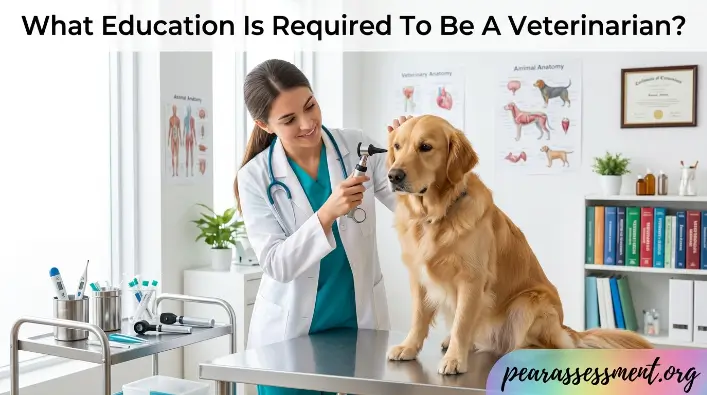
Welcome to Pear Assessment. If you are wondering what education is required to be a veterinarian, the answer depends partly on the country where you plan to practice. In Pakistan, aspiring veterinarians generally begin with a science-based intermediate qualification such as F.Sc. Pre-Medical and then apply for a Doctor of Veterinary Medicine (DVM) program. The DVM combines classroom learning with laboratory, clinical, hospital, farm, and field training.
Becoming a veterinarian requires more than simply studying animals. You need a strong foundation in biology and other sciences, a professional veterinary medicine degree, practical clinical experience, and the appropriate professional registration. Understanding each stage before you apply can help you choose the right subjects, university, and career path.
What Education Is Required to Be a Veterinarian?
The core professional qualification for a veterinarian is a Doctor of Veterinary Medicine (DVM) or an equivalent veterinary medicine degree recognized by the relevant authority.In Pakistan, the DVM is structured as a five-year professional degree. Pakistan Veterinary Medical Council (PVMC) regulations describe the DVM as a five-year course consisting of 10 regular semesters, including a compulsory six-month internship. The program also includes training in veterinary hospitals, livestock farms, and field settings.
What Degree Do You Need to Become a Veterinarian?
To become a veterinarian, you need a professional veterinary medicine degree, usually called a Doctor of Veterinary Medicine (DVM). This degree teaches you how to examine animals, diagnose diseases, provide treatment, perform medical procedures, and prevent illness.In Pakistan, students typically enter a five-year DVM program after completing F.Sc. Pre-Medical or an equivalent qualification. For example, UVAS currently lists F.Sc. Pre-Medical or equivalent education as an admission route for its DVM program.
Doctor of Veterinary Medicine (DVM)
During the degree, students move from basic scientific concepts to increasingly specialized veterinary subjects. The curriculum normally covers animal anatomy, physiology, microbiology, pathology, pharmacology, animal nutrition, medicine, surgery, reproduction, public health, and clinical practice.
The goal is not simply to teach students about animals. Veterinary education prepares graduates to make medical decisions, perform examinations and procedures, understand diseases, use diagnostic tools, prescribe appropriate treatments where permitted, and communicate effectively with animal owners and other professionals.
Is a Bachelor’s Degree Required Before a DVM?
This is one area where students often become confused because veterinary education differs between countries.In Pakistan, a separate bachelor’s degree is generally not the standard prerequisite for entering the DVM. Students can apply after completing the required intermediate-level qualification, such as F.Sc. Pre-Medical, if they meet the university’s admission criteria.
UVAS describes its DVM as a five-year degree and lists F.Sc. Pre-Medical with a minimum of 60% marks as an eligibility route.In other countries, the route can be different. For example, the U.S. system generally involves undergraduate-level preparation followed by admission to a professional veterinary medicine program.
Read Also: Missouri Higher Education Loan Authority: A Complete Guide
What Subjects Should You Study Before Becoming a Veterinarian?
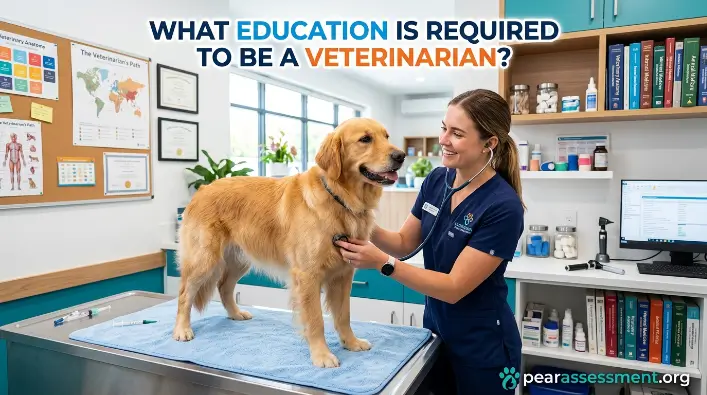
A strong science background is one of the most important foundations for veterinary education. Before entering a DVM (Doctor of Veterinary Medicine) program, students should focus on subjects that help them understand how living organisms function, how diseases develop, and how medicines affect the body.In Pakistan, F.Sc. Pre-Medical is a common route for students who want to apply for DVM programs. The subjects you study at this stage can make the transition to veterinary education much easier.
Biology
First, biology helps you understand how an animal’s body works. You learn about cells, tissues, organs, genetics, reproduction, and body systems. This knowledge becomes useful later when you study subjects such as animal anatomy, physiology, and pathology in a DVM program.
Second, biology helps you understand animal diseases and how the body responds to them. When an animal becomes sick, a veterinarian needs to understand what is happening inside its body, how the disease affects different organs, and how the immune system responds. A strong background in biology makes these veterinary subjects much easier to understand.
Chemistry
First, chemistry helps you understand how medicines work inside an animal’s body. During a DVM, you may study pharmacology, where you learn about different medicines, their effects, how they are absorbed, and how they should be used. Basic chemistry makes these concepts easier to understand.
Second, chemistry is useful for understanding body functions and laboratory tests. Veterinarians may examine blood, urine, or other samples to identify health problems. Knowledge of chemistry helps students understand substances in the body, changes caused by disease, and how laboratory results can provide clues about an animal’s health.
What Are the DVM Admission Requirements in Pakistan?
If you want to study Doctor of Veterinary Medicine (DVM) in Pakistan, you generally need to complete F.Sc. Pre-Medical or an equivalent qualification and meet the admission requirements of the university you choose. The exact criteria can vary between universities and may also change from one admission year to another.Before applying, students should check the university’s latest official admission notice rather than relying on old information.
F.Sc. Pre-Medical or Equivalent Qualification
For students in Pakistan, F.Sc. Pre-Medical is one of the main educational routes into a DVM program. Subjects such as Biology, Chemistry, and Physics provide the scientific foundation needed for veterinary studies.
For example, UVAS currently lists F.Sc. Pre-Medical or an equivalent qualification among the eligibility requirements for its DVM program. The university’s current criteria should always be checked before applying because admission policies can change.
Minimum Marks and Merit
First, meeting the minimum marks only makes you eligible to apply; it does not guarantee a seat. For example, if a university requires 60% marks for DVM admission, a student with exactly 60% may be allowed to apply, but students with higher marks may rank above them during the merit process.
Second, your overall academic performance can affect your position on the merit list. Universities may consider marks from Matric/O-Level and F.Sc./A-Level or equivalent qualifications when calculating merit. Therefore, students should aim for the highest marks possible instead of targeting only the minimum percentage required for eligibility.
How Long Does It Take to Become a Veterinarian?
In Pakistan, the DVM itself is a five-year professional degree. During these five years, students gradually move from basic science subjects to advanced veterinary medicine, clinical work, and practical training.First, the early part of the DVM focuses more on building a strong scientific foundation. Students study subjects such as anatomy, physiology, biochemistry, microbiology, and other basic veterinary sciences.
Five-Year DVM Program
First, the first semesters focus on basic scientific and veterinary subjects. Students learn areas such as anatomy, physiology, biochemistry, microbiology, and other foundational subjects. These courses build the knowledge they need before moving into more advanced veterinary topics.
Second, the later semesters become more focused on clinical and practical learning. Students study veterinary medicine, surgery, animal diseases, diagnosis, treatment, and other specialized areas. They also get opportunities to apply their knowledge through practical work and clinical training, which prepares them for real veterinary practice.
Clinical Training and Internship
PVMC’s published regulations describe training in a teaching veterinary hospital, livestock farm, and field-training environments as part of the DVM course. The regulations also specify a compulsory six-month internship within the five-year program.
This practical component helps students move beyond theoretical knowledge and develop skills in areas such as animal examination, handling, diagnosis, treatment, surgery, preventive medicine, and professional communication.
What Do You Study in Veterinary School?
A DVM curriculum covers a wide range of subjects because veterinarians may work with pets, livestock, poultry, horses, and other animals. Students need to understand both the normal functioning of animals and the problems that can affect their health.First, students study the basic sciences that help them understand an animal’s body. These include subjects such as anatomy, physiology, biochemistry, microbiology, pathology, and pharmacology. This knowledge helps students understand how different organs work, how diseases develop, and how medicines affect animals.
Depending on the university and curriculum, students may encounter subjects and areas such as:
- Anatomy
- Physiology
- Biochemistry
- Microbiology
- Pathology
- Pharmacology
- Parasitology
- Animal nutrition
PVMC currently publishes a DVM curriculum and related veterinary education regulations, while university curricula provide the detailed subjects taught within individual programs.
The curriculum is intentionally broad because a veterinarian may eventually work with pets, livestock, poultry, horses, wildlife, laboratory animals, or other animal populations.
Is Practical Experience Important for Becoming a Veterinarian?
Yes, practical experience is very important because veterinary medicine cannot be learned entirely from books and lectures. Students need opportunities to apply their knowledge while working with real animals and observing how veterinary professionals handle different situations.First, practical experience helps students become comfortable handling animals. They learn how to approach, examine, restrain, and care for animals safely.
Animal Handling Experience
First, working with animals helps students become more confident and comfortable around different species. They can learn how animals behave, how to approach them safely, and how to handle them without causing unnecessary stress. This is especially useful because veterinarians may work with animals that are scared, aggressive, injured, or unfamiliar.
Second, early experience helps students understand the responsibilities involved in animal care. Simple activities such as observing animals, helping with their daily care, or spending time in a veterinary clinic can teach students about feeding, hygiene, behavior, and basic care. This experience can also help them decide whether veterinary medicine is genuinely the right career for them.
Clinical and Field Training
Instead of only studying the symptoms of a disease in a textbook, students may learn how a veterinarian approaches an actual case: taking a history, examining an animal, identifying possible causes, selecting diagnostic methods, and planning treatment.
PVMC’s DVM regulations specifically include teaching veterinary hospital, livestock farm, and field training as components of veterinary education.
What Happens After Completing a DVM?
Completing a DVM is an important step, but it is not necessarily the end of your professional development. After graduation, students can move toward professional registration, practical work, and different areas of veterinary medicine depending on their interests.First, graduates complete the required professional steps before practicing. This can include fulfilling internship requirements and completing the registration process with the relevant veterinary authority.
Veterinary Internship
First, the internship gives DVM students an opportunity to apply what they have learned in classrooms and laboratories. During this period, students can gain practical experience in areas such as examining animals, assisting with treatments, handling different cases, and working with veterinary professionals. This helps build confidence before entering professional practice.
Second, the internship is also important for completing the professional requirements of the DVM pathway. In Pakistan, PVMC regulations include a compulsory six-month internship within the five-year DVM course. Students should keep their internship certificate and other related documents safely because they may be needed when applying for professional registration.
Veterinary Career Options
First, a DVM allows graduates to work directly with animals in different healthcare settings. You can work in private veterinary clinics, animal hospitals, livestock farms, poultry operations, or government veterinary services. Depending on your interests, you may focus on pets, farm animals, poultry, horses, or other species.
Second, you are not limited to clinical practice after completing a DVM. Graduates can also explore careers in veterinary laboratories, pharmaceutical companies, animal nutrition, research, universities, public health, food safety, and wildlife. Some veterinarians continue their education and specialize in a particular area to develop advanced expertise.
Potential areas include:
- Small-animal veterinary clinics
- Veterinary hospitals
- Livestock medicine
- Poultry health
- Government veterinary services
- Animal production
- Veterinary laboratories
The best career path depends on your interests, additional training, location, and professional goals.
Common Mistakes Students Make When Planning a Veterinary Career
First, many students choose veterinary medicine without researching the education and admission requirements properly. They may assume that every university has the same eligibility criteria, fees, merit system, or admission process. Before applying, students should check the latest requirements of their preferred universities and make sure they meet the required academic qualifications.
Choosing Subjects Without Checking Admission Requirements
First, students should check the eligibility criteria of their preferred veterinary universities before choosing their intermediate subjects. Different universities may have specific requirements regarding subjects, minimum marks, or equivalent qualifications. Choosing subjects without checking these conditions can limit your options when you are ready to apply for a DVM.
Second, planning your subjects early can help you avoid problems later. If you already know which universities you want to target, review their latest admission requirements and choose an educational pathway that keeps you eligible. Also, check the requirements again before applying because admission policies can change from one year to another.
Assuming Every University Has the Same Criteria
First, students should not assume that the admission requirements of one veterinary university will automatically apply to another. One university may require a particular percentage, while another may have different merit calculations, age limits, entry requirements, or documentation. Checking these details early can help you avoid applying to a program for which you are not eligible.
Second, always use the university’s latest official admission notice when planning your application. Requirements can change between admission years, so information from an old article, social media post, or previous admission cycle may no longer be accurate. For example, UVAS publishes specific eligibility and age requirements for its DVM admissions, so students should check the current notice before applying.
Ignoring Practical Animal Experience
First, students should try to get some basic experience around animals before choosing veterinary medicine as a career. You do not need professional experience or years of animal handling before entering a DVM program. However, spending time with pets, livestock, or other animals can help you become more comfortable with their behavior and care.
Second, practical exposure can help you understand the less enjoyable side of veterinary work. Veterinary professionals may deal with injured, sick, frightened, or aggressive animals, not just healthy pets. Observing a veterinary clinic or helping with animal care can give you a more realistic idea of the responsibilities involved and help you decide whether this career suits you.
The best decision is therefore based on a realistic understanding of the profession rather than simply a love of animals.
Frequently Asked Questions
What degree is required to become a veterinarian?
In Pakistan, the main professional qualification is the Doctor of Veterinary Medicine (DVM). The Pakistani DVM is structured as a five-year professional degree, including practical and clinical training.
Can I become a veterinarian after F.Sc. Pre-Medical?
Yes, F.Sc. Pre-Medical is a standard educational route for DVM admission in Pakistan. For example, UVAS’s current 2026 eligibility criteria specify at least 60% marks in F.Sc. Pre-Medical or an equivalent qualification.
How Many Years Does It Take to Become a Veterinarian in Pakistan?
In Pakistan, the DVM program takes five years to complete. During these five years, students study both theoretical and practical subjects, starting with basic sciences and gradually moving toward veterinary medicine, disease diagnosis, treatment, surgery, and clinical training.
Is biology necessary to become a veterinarian?
Biology is extremely useful because veterinary medicine involves animal anatomy, physiology, genetics, disease, microbiology, and other biological sciences. F.Sc. Pre-Medical is also an important admission route for DVM programs in Pakistan.
Do veterinarians need an internship?
Practical internship training is part of the Pakistani DVM structure. PVMC regulations specify a compulsory six-month internship, and PVMC’s registration information lists an internship certificate among the documents required for professional registration.
Can I become a veterinarian without studying science?
For the standard DVM pathway in Pakistan, students should expect science-based admission requirements. For example, UVAS currently requires F.Sc. Pre-Medical or an equivalent qualification for DVM admission.
Conclusion
Becoming a veterinarian requires proper education, practical training, and a strong foundation in science. In Pakistan, students generally follow the path of F.Sc. Pre-Medical or an equivalent qualification followed by a five-year DVM program. During the DVM, they study subjects such as biology, anatomy, physiology, diseases, medicine, surgery, and animal care while also gaining practical experience.
If you are planning this career, focus on getting strong academic marks, checking the latest admission requirements, and choosing a recognized DVM program. Remember that becoming a veterinarian is not only about loving animals; it also requires dedication, scientific knowledge, practical skills, and the ability to handle challenging situations. With the right education and preparation, a DVM can lead to many rewarding career opportunities in veterinary medicine.