

What is PEAR Assessment in Edulastic refers to a digital method of measuring student learning through online tests and evaluations. It represents a structured approach to performance evaluation that allows teachers to monitor student progress with the help of technology. It is a modern assessment system within the Edulastic platform that supports student evaluation, online testing, and performance tracking. It makes classroom assessment quicker, simpler, and more precise than traditional paper-based exams.
Today, education is increasingly shifting toward digital learning, making tools like What is PEAR Assessment in Edulastic increasingly valuable. Many teachers face difficulties with lengthy grading processes and unclear reports on student performance. This system addresses these challenges by providing instant results and detailed learning analytics. It also supports stronger classroom engagement and improves teaching efficiency. As a result, schools are increasingly using it to create smarter learning environments.
In addition, PEAR Assessment in Edulastic focuses on more than simply testing students; it also supports improved learning outcomes. It generates detailed reports that highlight student strengths and areas that need improvement. Teachers can use this information for formative assessment, summative evaluation, and skill-based learning improvement. This makes it a useful tool for teachers and students in today’s digital classrooms.
Understanding Edulastic Platform
Edulastic is a modern digital education platform created to make student assessment simpler, quicker, and more accurate for teachers and schools. It functions as an online system where teachers can create tests, assign homework, and assess student performance in real time. The primary purpose of Edulastic is to improve classroom assessment and support digital learning environments through technology-based tools that replace traditional paper exams.
What is Edulastic?
Edulastic is an online assessment platform used by schools to measure student learning through digital quizzes and tests. It allows teachers to develop customized assessments according to different subjects and difficulty levels. The platform is commonly used for both formative assessment and summative testing, making it useful for regular practice as well as final examinations. With Edulastic, teachers can monitor student progress more easily and refine their teaching approaches.
It provides real-time evaluation while reducing the amount of manual grading teachers need to complete. Students can complete tests on computers or tablets, with results produced immediately. This makes the learning process more interactive and efficient for teachers and students alike.
Key Features of Edulastic
Edulastic provides useful features that enhance the overall teaching and learning process. One key feature is its extensive question bank, which allows teachers to quickly choose or develop questions. It also provides auto-grading, saving time by checking responses automatically and delivering results instantly. Teachers can use analytics features to track student performance and support better learning outcomes.
The platform is built to support data-driven education and real-time feedback systems. It enables teachers to recognize areas where students are struggling and modify their teaching strategies when needed.
- Question bank system for simple test creation
- Auto-grading with immediate feedback for students
- Teacher dashboard for monitoring performance
- Advanced analytics for student performance tracking
- Support for custom assessments and learning evaluation
Read Also: how to print a test on Pear Assessment
What is PEAR Assessment?
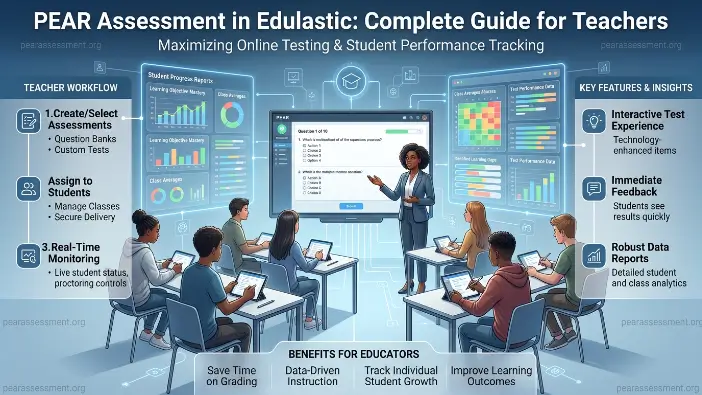
PEAR Assessment is a modern digital evaluation system used in education to measure student learning and performance in a structured, data-focused way. It stands for Performance Evaluation and Assessment Reporting, helping teachers understand student learning through regular testing and feedback. The primary purpose of PEAR Assessment is to support learning outcomes, student evaluation, and academic performance tracking within today’s digital education systems.
Meaning of PEAR in Education
The meaning of PEAR in education is connected to a structured approach that evaluates student performance through technology. It is designed to replace traditional examination methods with more advanced digital tools. The concept of PEAR Assessment allows schools to monitor student progress more accurately and consistently.
It is mainly used to strengthen teaching quality and give teachers clearer insights into student learning behavior. This makes the educational process more efficient and focused on results.
- PEAR stands for Performance Evaluation and Assessment Reporting
- Focuses on digital student assessment systems
- Helps improve academic performance tracking
- Supports modern education evaluation methods
How PEAR Assessment Works in Edulastic
PEAR Assessment in Edulastic follows a straightforward digital process in which teachers create tests, students complete them online, and results are automatically produced. Teachers first develop assessments according to learning objectives and then assign them to students through the Edulastic platform. This approach makes online testing and real-time evaluation easier to manage.
Once students submit their work, the system reviews their answers and creates detailed reports. These reports allow teachers to identify student strengths and weaknesses more clearly.
- Test creation using digital assessment tools
- Student participation through an online platform
- Instant result generation and performance analytics
- Automated reporting system for teachers
Types of PEAR Assessments
PEAR Assessment offers various types of evaluations that measure student learning at different stages. Each assessment serves a particular purpose within the learning process. Together, these assessments help teachers monitor progress, identify learning gaps, and evaluate final performance effectively.
They are commonly used in schools to support continuous improvement and develop better teaching strategies.
- Formative assessment: used during learning to monitor progress
- Summative assessment: used at the end of lessons or units
- Diagnostic assessment: identifies student weaknesses at an early stage
- Supports continuous learning evaluation
- Improves data-based teaching decisions
Key Features of PEAR Assessment in Edulastic
PEAR Assessment in Edulastic offers advanced tools that make student evaluation more efficient and precise. It follows a structured approach based on academic standards while providing teachers with real-time information about student performance. This system supports digital learning assessment, student progress tracking, and data-driven teaching decisions in modern classrooms.
It allows teachers to save time and identify learning gaps more quickly. Students also receive immediate feedback, helping improve their learning pace and understanding. Overall, it makes classroom evaluation more organized, effective, and intelligent.
- Standards-based evaluation system ensures fair and consistent academic assessment.
- Real-time feedback supports instant learning improvement
- Data analytics dashboard enables performance tracking and reporting
- Adaptive learning insights adjust difficulty according to student level
- Advanced tools help monitor student progress and skill development
Benefits of PEAR Assessment in Edulastic
PEAR Assessment in Edulastic offers significant benefits to teachers, students, and schools by improving how learning is measured through digital assessment tools and real-time performance tracking. It makes evaluation quicker, simpler, and more accurate. Teachers save time, students receive immediate feedback, and schools can make stronger academic decisions using data-driven insights and modern education technology systems.
Benefits for Teachers
PEAR Assessment in Edulastic helps teachers lower their workload while improving teaching quality. It automates grading and provides useful insights into student learning progress.
- Saves time with an automated grading system
Teachers no longer need to check papers manually, reducing their workload and giving them more time to focus on teaching. - Better understanding of student performance data
Teachers can easily identify which students are performing well and which students require additional support. - Easy test creation process
Teachers can quickly prepare quizzes and exams with ready-made tools and question banks.
Benefits for Students
For students, PEAR Assessment in Edulastic creates a better learning experience by providing instant feedback and personalized support.
- Instant feedback on answers
Students can quickly identify their mistakes and correct them, supporting better learning. - Personalized learning experience
The system responds to student needs and allows them to learn at their own pace. - Improved concept understanding
Students can understand topics more clearly through repeated practice and straightforward explanations.
Benefits for Schools
Schools can use PEAR Assessment in Edulastic to improve academic planning and maintain consistent evaluation standards.
- Data-driven academic planning
Schools can use performance information to improve teaching strategies and curriculum planning. - Standardized evaluation system
All students are evaluated through the same approach, helping maintain fairness in grading. - Improved learning outcomes
Better progress tracking and feedback can contribute to improved student results and overall school performance.
How to Use PEAR Assessment in Edulastic (Step-by-Step Guide)
PEAR Assessment in Edulastic follows a straightforward digital process that helps teachers manage online testing in an organized manner. It supports classroom assessment, student evaluation, and learning analytics through modern tools. Teachers begin by creating an account, setting up a class, developing assessments, assigning them to students, and then reviewing the results. This step-by-step approach makes online education more organized and efficient. It saves time, minimizes manual tasks, and supports teaching quality through real-time feedback and performance tracking in schools.
Step 1 – Create Account
To begin using PEAR Assessment in Edulastic, teachers first need to register for an account on the platform. This provides access to its digital assessment tools and features. After registration, users can easily explore dashboards, question banks, and platform settings.
The sign-up process is straightforward and quick. Teachers only need basic information such as their email and school details. After registration, they can start using online teaching tools effectively for classroom management.
Step 2 – Set Up Class
Once the account is created, teachers can set up a class within PEAR Assessment in Edulastic. This helps arrange students into groups for improved learning management. It also supports organized classroom evaluation.
Teachers can enter student names or invite students with codes. This makes the digital classroom setup simple and efficient. It also supports smooth interaction between teachers and students.
Step 3 – Create Assessment
At this stage, teachers use PEAR Assessment in Edulastic tools to create tests. They can select questions from the question bank or create their own. This supports better test customization and learning assessment quality.
The platform supports various question formats, including MCQs and short answers. Teachers can also align assessments with academic standards to improve accuracy and results.
Step 4 – Assign to Students
After completing the assessment, teachers assign it to students through PEAR Assessment in Edulastic. This makes online test distribution quick and straightforward.
Students receive notifications and can complete the assessments on their devices. This supports remote learning and allows students to participate smoothly without unnecessary delays or confusion.
Step 5 – Analyze Results
After students submit their assessments, PEAR Assessment in Edulastic automatically creates reports. Teachers can easily review scores and performance analytics.
The results help teachers identify student strengths and weaknesses. This supports data-driven teaching and helps with better academic planning for upcoming lessons.
Common Mistakes Teachers Make
Many teachers can make mistakes when using PEAR Assessment in Edulastic and other digital assessment tools, which may reduce learning effectiveness. A common issue is failing to align assessments with curriculum standards, resulting in weak academic alignment. Another mistake is using too many tests without a clear purpose, which can affect student engagement. Teachers may also overlook analytics and reports, causing them to miss valuable performance insights. Poorly designed questions can further reduce learning quality. Avoiding these issues can strengthen classroom assessment and support better student learning through organized teaching methods.
- Not aligning assessments with curriculum standards.
This can result in weak learning objectives, making it harder for students to understand the required topics or skills. - Overusing tests without purpose
Excessive exams can create stress and reduce student motivation instead of supporting better learning outcomes. - Ignoring analytics and reports
Teachers can miss valuable performance data that reveals student strengths and areas that need improvement. - Poor question design
Poorly written questions can lower assessment quality and confuse students rather than accurately measuring their understanding.
PEAR Assessment vs Traditional Assessment
PEAR Assessment in Edulastic is a modern digital assessment system that differs significantly from traditional paper-based examinations. It improves student evaluation by providing faster results and greater accuracy. Traditional assessment usually relies on manual checking, while PEAR uses automated tools to provide instant grading. It also offers stronger learning analytics and feedback for teachers and students. Overall, it makes classroom assessment more efficient, organized, and useful for modern education systems.
- Digital vs paper-based comparison
Digital systems such as PEAR Assessment use online tools, while traditional methods depend on paper exams that require more time and effort. - Speed and accuracy differences
PEAR provides immediate results with high accuracy, whereas traditional exams require more time and can involve human grading errors. - Feedback and analysis comparison
PEAR delivers real-time performance feedback, while traditional methods often provide delayed and less detailed analysis. - Effectiveness in modern education
Digital assessment supports learning outcomes and modern education technology systems more effectively than traditional methods.
Frequently Asked Questions
What is the main purpose of PEAR Assessment in Edulastic?
The main purpose is to simplify student evaluation using digital tools and provide teachers with clear insights into learning progress through automated reports and performance tracking.
Can the PEAR Assessment be used for all subjects in schools?
Yes, it can be applied to almost all academic subjects because it supports customizable tests, making it flexible for different curriculum needs and teaching styles.
How does Edulastic improve classroom teaching?
Edulastic improves teaching by reducing grading time, offering instant feedback, and helping teachers identify learning gaps more quickly and accurately.
Is the PEAR Assessment suitable for remote learning?
Yes, it works well for remote learning because students can take tests online from anywhere, and teachers can monitor results in real time.
Why is digital assessment better than traditional exams?
Digital assessment is faster, more accurate, and provides detailed insights, while traditional exams are slower and often lack real-time feedback and deep analysis.
Conclusion
PEAR Assessment in Edulastic is a modern and smart way of evaluating student performance. It helps teachers save time and improve accuracy through digital assessment tools. The system supports better classroom management and gives real-time insights into student learning. It also makes testing easier, faster, and more organized for schools.
Overall, this platform improves the education system by replacing traditional exams with advanced online evaluation methods. Students get instant feedback, and teachers can track progress easily. It creates a more effective and balanced learning environment. In today’s digital world, PEAR Assessment plays an important role in improving teaching and learning quality.