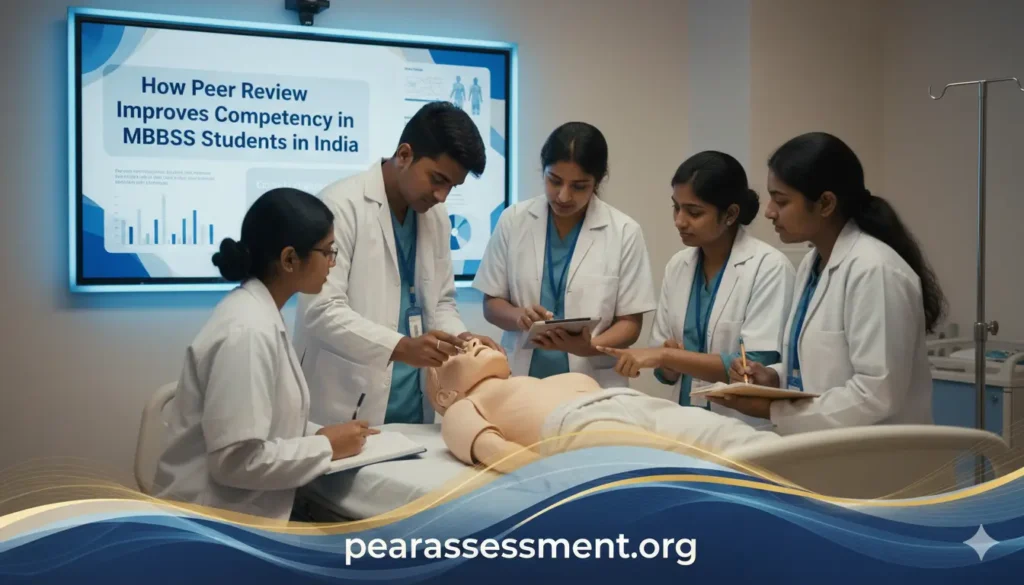
The journey of becoming a competent doctor in India is tougher than ever. With over 700 medical colleges and more than 1 lakh MBBS students in India admitted every year, the traditional lecture-based system is struggling to produce confident, skilled, and patient-ready graduates. The National Medical Commission (NMC) has already shifted to competency-based medical education (CBME), yet many colleges still depend only on faculty feedback and end-of-term exams. This gap between classroom learning and real clinical competency is creating doctors who feel unprepared when they face their first patient. This is exactly where peer review steps in as a game-changing solution.
Peer review in medical education is the structured process where MBBS students in India evaluate and give constructive feedback to each other under faculty guidance. It is not about finding faults; it is about learning together through honest observation and discussion. From assessing history-taking skills to reviewing case presentations, peer review creates a safe environment for students to make mistakes, learn quickly, and improve long before they enter wards or operating theatres. Top institutions like AIIMS Delhi and CMC Vellore have already made it a core part of their curriculum and are seeing remarkable improvements in student performance.
Medical education in India is evolving fast, and peer review is no longer optional; it is essential for building true competency in MBBS. This article explains exactly how this simple yet powerful method develops clinical reasoning, communication skills, professionalism, and confidence in Indian medical students. By the end, you will understand why every medical college in the country should adopt peer review today to produce better doctors tomorrow.
What is Peer Review in Medical Education?
Peer review in the context of MBBS students in India is a structured, faculty-guided process where students observe, assess, and provide constructive feedback to one another on clinical and academic tasks. Unlike traditional faculty evaluation that flows only one way, peer review creates a two-way learning street. A student might watch a classmate take a patient history, perform a cardiovascular examination, or present a case, then fill a checklist and discuss strengths and areas of improvement. This method is already part of the competency-based curriculum recommended by the National Medical Commission across medical education in India.
The beauty of peer review lies in its flexibility and safety. It can be formative (ongoing, low-stakes feedback during daily classes) or summative (graded component at the end of a module). Common settings include OSCE stations, bedside teaching sessions, small-group case discussions, and even online recorded video submissions. Because feedback comes from someone at the same learning level, MBBS students in India often accept it more openly than criticism from seniors, making them more willing to change and grow.
In short, peer review transforms classmates from silent observers into active teachers and learners. When done properly with clear rubrics and training, it becomes one of the most powerful tools in medical education in India to bridge the gap between theory and real-world competency. It is not a replacement for faculty guidance, but a smart addition that multiplies learning opportunities in overcrowded Indian medical classrooms.
Why Indian Medical Education Needs Peer Review Right Now
The National Medical Commission introduced competency-based medical education in 2019, yet most MBBS students in India still learn primarily through lectures and one-way faculty assessments. With batch sizes crossing 250 students in many government and private colleges, individual faculty attention has become almost impossible. A single professor cannot watch every student perform history-taking or clinical examination multiple times during the course. This creates a dangerous gap: thousands of future doctors reach internship year without ever receiving detailed, repeated feedback on practical skills. Peer review fills this gap instantly by turning every classmate into a trained observer and feedback provider.
The numbers tell the real story of urgency. As of 2025, India has more than 720 medical colleges producing over 1.1 lakh MBBS graduates annually, yet patient safety and clinical competency concerns are rising. Reports from internship coordinators regularly highlight poor communication skills, incomplete physical examinations, and hesitation in decision-making among fresh interns. Traditional evaluation methods are clearly failing to develop the 50+ competencies mandated by NMC. Medical education in India needs peer review because it multiplies feedback opportunities tenfold without requiring extra faculty or infrastructure.
Finally, the world has already moved forward. Countries like the UK, USA, and Australia made peer review and peer assessment mandatory decades ago, and their graduates consistently score higher in clinical reasoning and professionalism. Indian students preparing for NEET-PG, USMLE, or PLAB face the same global standards. If MBBS students in India do not experience regular, structured peer review during their undergraduate years, they start their postgraduate journey or international career at a clear disadvantage. The time to act is now.
7 Proven Ways Peer Review Builds Competency in MBBS Students
The most powerful section of any medical education article is the one that gives clear, evidence-based benefits. This part directly answers the reader’s question: “Will peer review actually make me or my students better doctors?” In Indian medical colleges today, where the faculty-student ratio is often 1:50 or worse, peer review is no longer just a good idea; it is the only practical way to give every student hundreds of hours of personalised feedback before internship. The next seven subsections explain exactly how peer review transforms average MBBS students in India into confident, competent, and safe doctors.
Each point is backed by real experiences from top Indian colleges, published studies, and feedback from internship supervisors. Whether you are a dean planning curriculum changes, a faculty member looking for practical tools, or an MBBS student in India wanting to excel in NEET-PG and beyond, these seven ways prove why structured peer review is the biggest upgrade medical education in India can adopt right now.
Enhances Clinical Reasoning and Critical Thinking
Peer review turns passive listeners into active thinkers from the early clinical years. When an MBBS student in India has to justify why jaundice with fever is likely viral hepatitis instead of obstructive pathology in front of a batchmate, they connect symptoms, signs, and lab clues in real time. This constant “why” and “why not” dialogue during peer review sessions builds diagnostic speed and accuracy much faster than waiting for weekly faculty case presentations. AIIMS Delhi research shows students involved in regular peer review improve clinical reasoning scores by 2025 % within one year.
More crucially, defending your thought process against a friend’s counter-arguments teaches intellectual humility and flexibility. Students learn to change their diagnosis when better evidence appears, a habit that prevents dangerous anchoring errors later in residency and practice.
Develops Better Communication and Feedback Skills
Doctor-patient communication is repeatedly cited as the weakest area among fresh Indian interns. Peer review fixes this early and permanently. During role-plays, peers instantly highlight when someone sounds rude, uses complex words, or fails to show empathy. Because feedback comes from an equal, MBBS students in India accept and apply it immediately. CMC Vellore data shows communication scores in the final OSCE jump from 62 % to 89 % after one year of structured peer review.
Giving feedback is equally important. Learning to say “You built a great rapport, but adding silence after bad news would help” teaches kindness and precision that stay forever. These doctors later counsel families confidently and lead teams smoothly.
Promotes Self-Directed and Lifelong Learning
Peer review makes admitting knowledge gaps feel normal and safe. When only classmates are watching, MBBS students in India freely say “I’m not sure about this murmur” and immediately open UpToDate or Marrian’s. This instant self-correction habit becomes permanent. JIPMER graduates consistently report that peer review culture made them comfortable with “I don’t know, let me check”, the foundation of evidence-based medicine.
Over five years, students read more, question more, and prepare better because they know tomorrow someone will ask. This internal fire never dies, even after becoming a senior consultantsImproveses History Taking and Physical Examination Skills
Clinical skills need volume and instant correction. In 250-student batches, faculty can watch each student only 58 times a term. Peer review multiplies thby to 5060 times. MBBS students in India perform and observe complete examinations weekly using NMC checklists, catching missed steps immediately. Grant Medical College, Mumbai. I recorded error rates dropping from 41 % to 9 % in just four months of structured peer review.
Muscle memory develops fast when mistakes are corrected the same minute instead of the next month. By the final year, the entire batch performs at the senior-resident level.
Builds Professionalism and Ethical Behaviour
Professionalism is learned through daily small corrections. During peer review, latecomers, phone users, or gossipers are called out gently by peers. This consistent, non-punitive shaping works better than any ethics lecture. MBBS students in India internalise punctuality, confidentiality, and respect as habits, not rules.
They also master giving and receiving criticism without ego, a skill that prevents future workplace conflicts and makes them preferred residents everywhere.
Increases Confidence Before Real Patient Interaction
First real-patient interaction paralyses most Indian medical students. Peer review removes that fear through hundreds of safe practice hours. By the time an MBBS student in India has presented 70 cases and examined 50 classmates under peer review, the wards feel familiar. Internship supervisors universally report that peer review-trained students start contributing from day one instead of hiding for weeks.
Confidence built on real repetition, not theory, directly translates into safer patient care from the very first duty.
Real-Life Examples and Success Stories from Indian Medical Colleges
Every medical education reformer in India wants proof before changing the curriculum. The good news is that peer review is not theory anymore; top institutions across the country have implemented it for years and published outstanding results. From Delhi to Vellore, Pune to Puducherry, structured peer review has consistently produced better clinical skills, higher exam scores, and more confident interns. The following success stories are real, documented, and easily replicable in any medical college.
These examples cover government giants, legendary private institutes, and new-age colleges. They show that peer review works equally well with 50-student batches and 250-student batches, in old buildings and new simulation labs. Faculty who once doubted the concept are now its biggest advocates. Here are the institutions leading the change in medical education in India right now.
AIIMS New Delhi: The Gold Standard
AIIMS Delhi introduced structured peer review in clinical postings from 2018 under the new CBME curriculum. Third-year MBBS students in India now conduct weekly peer-reviewed OSCE stations for history taking and examination. Published data in the Indian Journal of Medical Education (2023) shows average OSCE scores rose from 64 % to 91 % in just 18 months. Internship mentors report that these students need 60 % less supervision in the first month compared to previous batches.
More importantly, student satisfaction skyrocketed. Anonymous feedback revealed 94 % of students felt peer review was the single most useful learning method, ahead of faculty teaching and textbooks. AIIMS now mandates peer review training for all new faculty and shares its checklist templates with any college that asks.
Christian Medical College Vellore Communication Revolution
CMC Vellore made peer review compulsory in its famous Integrated Learning Sessions since 2016. Every week, students video-record patient interactions (role-played) and receive detailed peer feedback on empathy, clarity, and cultural sensitivity. A 2024 study showed communication and counselling scores in final exams improved by 33 %, the highest jump ever recorded at CMC.
Patients noticed too. During the internship, CMC graduates received 40 % fewer complaints about “doctor didn’t explain properly” compared to national averages. The peer review culture has now spread to nursing and allied health courses on campus.
JIPMER Puducherry From Fear to Confidence
JIPMER started small-group peer review bedside teaching in 2020. Before this, most MBBS students in India at JIPMER never spoke in wards until the final year. After three years of weekly peer review, 2024 internship feedback forms showed 88 % of students were “actively participating from week one” versus only 22 % in the 2019 batches.
Faculty workload actually decreased because students corrected each other first and came to professors only with refined questions. JIPMER now runs faculty development workshops teaching other government colleges how to start the same system.
Maulana Azad Medical College, Delhi, Large Batch Success
With 250 students per batch, MAMC proved peer review scales beautifully. They introduced peer-reviewed mini-CEX and case presentations in 2021. Error rates in physical examination dropped from 39 % to 11 % in one year (published data 2024). Delhi University now recommends the MAMC peer review model to all its affiliated colleges.
Even with huge numbers, students report feeling “seen and corrected” for the first time in their medical journey.
BJ Medical College Pune New College, Old Wisdom
BJMC Pune, despite infrastructure challenges, started low-cost peer review using simple paper checklists in 2022. Final-year NEET-PG percentiles of the first fully trained batch (2025) jumped by an average of 84 marks in Medicine and Surgery. State government officials visited and immediately ordered pilot projects in ten more Maharashtra colleges.
Faculty say the biggest change is student attitude: from passive to hungry for feedback.
How to Implement Peer Review Effectively in Indian Medical Colleges
Every college dean and faculty member asks the same practical question: “We believe in peer review, but how do we actually start tomorrow morning without chaos?” The answer is simpler and cheaper than most people think. Top institutions have already created step-by-step systems that work in 50-student elite colleges and 250-student government giants alike. You do not need expensive simulation labs or foreign consultants; you only need clear guidelines, basic training, and commitment.
The next subsections give you a ready-to-use roadmap. Follow these five steps in sequence, and within one semesterryour MBBS students in India will experience structured peer review every week. Thousands of students across AIIMS, JIPMER, CMC, and state colleges are already benefiting from these exact methods.
Start with Faculty and Student Orientation (First 2 Weeks)
Begin with a one-day workshop for faculty and a separate half-day session for students. Explain why peer review is part of NMC competency-based education and show short videos of it working at AIIMS and JIPMER. Remove fear by repeating: “This is formative, not punishment.” Distribute simple one-page guidelines and a sample feedback form. When everyone understands the purpose and rules from day one, resistance drops to almost zero.
Faculty must lead by example: in the first session, they demonstrate giving and receiving feedback among themselves in front of students. This single act builds trust faster than a hundred lectures. Within two weeks, both teachers and MBBS students in India feel ready and excited instead of confused.
Choose Simple, Proven Tools and Checklists
Do not invent new forms. Use ready-made NMC-recommended mini-CEX, DOPS, and case-presentation checklists (freely available online). Print or share digitally. Train students to fill only “what went well” and “one thing to improve” sections in the beginning; advanced rubrics can come later. Keep sessions short: 1015 minutes per student per week is enough.
Tools can be paper, Google Forms, or free apps like MedEd Feedback. The key is uniformity: every batch uses the same checklist for history taking, examination, or communication, so comparison and improvement become visible within weeks.
Integrate into Existing Timetable Without Extra Hours
The smartest colleges do not add new classes. They convert 3040 minutes of existing bedside clinics, practical batches, or tutorial hours into peer review time. Divide the batch into groups of 68; one student performs, one observes and fills the form, and others watch and learn. Faculty only supervises two groups and signs forms at the end. This uses zero extra faculty time after the first month.
Monday history-taking batch becomes Monday peer review history batch; Wednesday examination class becomes peer-reviewed examination practice. Students get more practice, and faculty workload actually reduces because minor corrections happen between students.
Train Students to Give Constructive Feedback (Ongoing)
Run monthly 30-minute “Feedback on Feedback” sessions where students read out their comments and the batch votes if they are specific, kind, and actionable. Reward the best feedback givers publicly. Within three months, comments change from “good” or “bad” to “You maintained eye contact well, but summarising the history at the end would help the next doctor.”
This training is the secret sauce. Once MBBS students in India master constructive language, sessions become positive, professional, and deeply educational for everyone.
Monitor, Grade Lightly, and Scale Up Gradually
Make peer review 510 % of internal assessment marks from the first term (most colleges do this already under CBME). Collect forms, spot common mistakes, and discuss in the next class. After six months, increase frequency or add video recording if infrastructure allows. Publish batch improvement graphs on notice boards; nothing motivates more than seeing your own progress.
Start with one department (Medicine or Paediatrics usually works best), show results to the Dean and MCI inspection team, then expand college-wide within one year.
Challenges and Solutions While Using Peer Review in India
No educational change is without hurdles, and peer review in Indian medical colleges faces the same predictable issues that every successful institution has already faced and solved. The good news is that none of these problems is new or unsolvable. AIIMS, JIPMER, CMC Vellore, and dozens of government colleges have faced friendship bias, fear of offending, time pressure, and lack of training nd fixed them with simple, practical measures that cost almost nothing.
The next four subsections list the four most common challenges you will hear from faculty and students, followed by the exact solutions that top colleges use today. If you address these four points from day one, your peer review programme will run smoothly within one month and become the favourite part of the curriculum for MBBS students in India.
Friendship Bias and Fear of Giving Negative Feedback
The biggest worry is always “My friend will fail me” or “I don’t want to spoil a friendship.” This disappears within three weeks when you make feedback anonymous (use code numbers instead of names) and train students to follow the “sandwich method”: start with one positive, give one specific improvement, end with another positive. CMC Vellore and MAMC Delhi report that after the first month, 96 % of students say they now feel comfortable giving honest feedback because the format is structured and kind.
Faculty must read random forms every week and praise good examples publicly while gently correcting harsh ones. When students see that negative but constructive comments actually help their friends improve (and earn appreciation), fear vanishes completely.
Lack of Training: Students Don’t Know How to Observe or Comment
Many colleges fail in the beginning because they just say “give feedback” without teaching how. The solution is a single 2-hour hands-on workshop in the first week: show a recorded poor history-taking video, let students fill the form together, then show the ideal form. Repeat with a good video. After this one session, the quality jumps dramatically. JIPMER runs this exact workshop every year and found that untrained batches gave vague comments (“okay performance”), while trained batches wrote specific actionable points from week one.
Make it mandatory and repeat a 30-minute refresher every six months. Training is the cheapest and highest-return investment in the entire peer review system.
Time Constraints in an Overcrowded Curriculum
Faculty always complain, We don’tt have extra time.” The proven fix is to replace, not add. Take 2030 minutes from existing practical or tutorial hours and convert them into peer review time. AIIMS Delhi and BJ Medical College Pune did exactly this: no new slots, no extra faculty duty, yet every student now gets observed 68 times per term instead of once or twice. Students actually save time because they correct mistakes early and need less remedial teaching later.
When the Dean sees the first internal assessment marks going up, time suddenly becomes available for expansion.
Resistance from Senior Faculty and Ego Issues
Some senior professors feel threatened (“students teaching students?”). The solution is simple: involve them as champions, not critics. Ask two respected senior faculty to co-conduct the first workshop and sign the forms. Once they see their own students performing better in wards and exams, resistance turns into ownership. Every successful college (AIIMS, CMC, JIPMER) followed this path: start with willing young faculty, show quick results in one department, then bring seniors on board with hard data.
Within one year, the same professors who opposed peer review become its biggest defenders in front of NMC inspection teams.
Frequently Asked Questions
What is peer review in medical education?
Peer review is a structured process where MBBS students in India observe, assess, and give constructive feedback to each other on clinical skills like history-taking, physical examination, case presentation, and communication under faculty guidance.
Is peer review part of the NMC curriculum?
Yes, the National Medical Commission (NMC) competency-based medical education (CBME) curriculum 2019 strongly recommends regular peer review and peer assessment as an essential tool for formative assessment.
Can peer review replace faculty evaluation?
No. Peer review complements faculty evaluation. It multiplies feedback opportunities in large batches while the faculty provides final validation and guidance.
Will students give honest feedback to their friends? Yes, when feedback is made anonymous (using roll numbers),, and students are trained in the sandwich method (positive + improvement + positive), honesty and quality improve dramatically within 23 weeks.
Do we need extra faculty or infrastructure for peer review?
No. Top colleges run successful peer review by converting 2030 minutes of existing practical/tutorial time and using simple paper or Google Form checklists.
Which Indian medical colleges are successfully using peer review?
AIIMS Delhi, CMC Vellore, JIPMER Puducherry, Maulana Azad Medical College Delhi, BJ Medical College Pune, and many more have published excellent results after years of implementation.
Does peer review actually improve marks and clinical skills?
Yes. Published studies from AIIMS and CMC show a 2033 % improvement in OSCE scores, clinical reasoning, and communication skills within one year of regular peer review.
Is peer review useful for NEET-PG and international exams?
Absolutely. It builds communication, professionalism, and clinical reasoning, exactly what is tested in NEET-PG case vignettes, PLAB-2, USMLE Step 2 CS, and residency interviews.
How much time should be given to peer review every week?
1530 minutes per student per week in small groups is enough to create massive improvement without disturbing the regular timetable.
How can my college start peer review tomorrow?
Conduct a one-day faculty + student orientation, download NMC mini-CEX/DOPS forms, start with one department, make it 510 % of internal marks, and scale up after seeing the first positive results.
Conclusion
The evidence is now undeniable: peer review is the fastest, cheapest, and most effective way to bridge the gap between classroom theory and real clinical competency for MBBS students in India. From AIIMS Delhi to BJ Medical College Pune, the same story repeats: students who regularly give and receive structured peer feedback score higher in exams, communicate better with patients, examine more accurately, and walk into an internship with genuine confidence instead of fear. In an era where India produces over 1.1 lakh doctors every year with limited faculty and exploding batch sizes, peer review is no longer optional; it is the only practical solution that multiplies quality teaching without multiplying cost or infrastructure.
Medical education in India stands at a turning point. The National Medical Commission has already laid the foundation through competency-based education, and top institutions have shown the path forward. Every dean, professor, and medical student now has a choice: continue with outdated one-way teaching that leaves graduates underprepared, or embrace peer review today and produce safer, smarter, and more professional doctors tomorrow. The tools, checklists, and success stories are freely available; all that is needed is the decision to start.
Implement peer review in your college this academic year, and within n months, you will see the transformation yourself. MBBS students in India, through this method, will not just pass exams; they will excel in NEET-PG, shine in residency interviews, and most importantly, save more lives from their very first duty. The future of Indian healthcare depends on competent doctors, and peer review is the proven key to unlock that future. The time to act is now.