
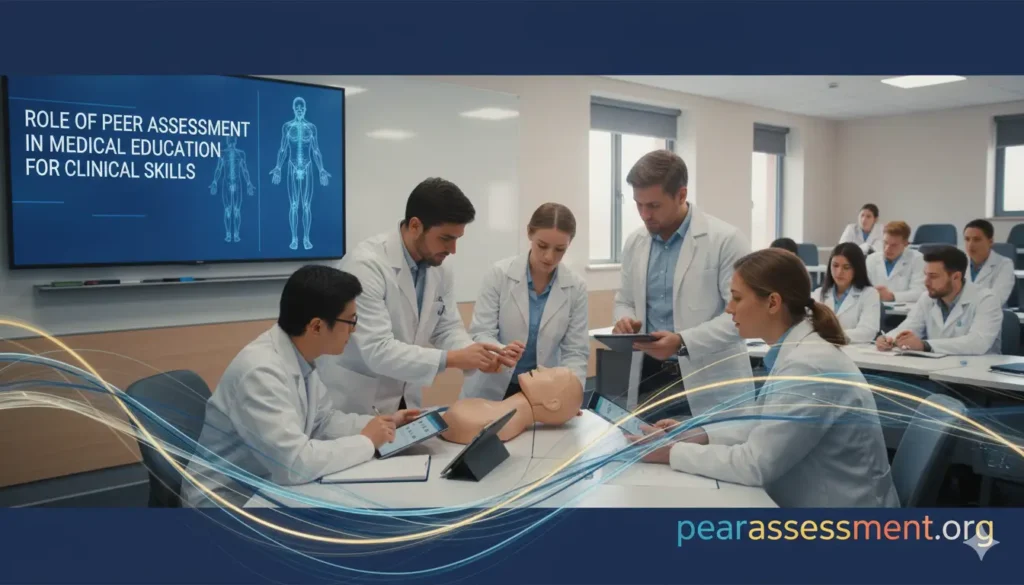
Teaching clinical skills has always been the most labour-intensive part of medical education. A single OSCE station needs one examiner for every 810 minutes of student time, bedside teaching rounds collapse when faculty numbers fall, and simulation suites sit half-empty because there are simply not enough tutors to go around. With medical school intakes rising globally (UK up 25 % since 2018, India doubling MBBS seats, US planning 30 % growth by 2030) and faculty shortages worsening, traditional one-to-one assessment is no longer sustainable. The role of peer assessment in medical education for clinical skills has moved from “interesting pilot” to “essential solution” in less than a decade.
Major regulatory bodies now openly endorse it. The UK General Medical Council (2022), the Association of American Medical Colleges (2023), and the World Federation for Medical Education (2024 standards) all explicitly recognise structured peer assessment of clinical and communication skills as valid, reliable, and educationally superior when properly implemented. Top institutions, including Imperial College London, Yong Loo Lin Singapore, Harvard, and Melbourne, have published data showing peer scores correlate 0.820.94 with faculty scores while dramatically reducing faculty workload. More importantly, students who regularly assess each other retain skills longer and score higher on real licensing examinations.
This guide examines the rapidly growing role of peer assessment in medical education for clinical skills through the latest evidence, real-world case studies from leading medical schools, and ten immediately usable methods you can introduce next term. Whether you run OSCE circuits, bedside teaching, or high-fidelity simulation, you will discover exactly how peers can safely and effectively take over large parts of formative (and even summative) assessment while actually improving learning outcomes. By the end, you will have everything needed to cut faculty time by 4070 % without compromising standards or patient safety.
What Peer Assessment Actually Means in Clinical Skills Training
In medical education, peer assessment is the structured process where students observe, evaluate, and give feedback to each other on clinical and professional performance using explicit, faculty-designed criteria. It is never casual “what did you think?” chat; it is deliberate, rubric-guided evaluation of history-taking, physical examination, communication, clinical reasoning, procedural technique, or teamwork. The role of peer assessment in medical education for clinical skills spans everything from low-stakes practice in Year 1 to high-stakes summative mini-CEX or OSCE stations in the final year.
Crucially, it comes in two flavours: peer feedback (formative, descriptive, non-graded) and peer grading (numerical scores or pass/fail that may contribute to final marks after faculty moderation). Most medical schools begin with pure feedback in early years and gradually introduce moderated grading once reliability is proven. Tools range from paper checklists during bedside teaching to video playback with timed annotations in simulation centres and mobile apps that deliver anonymous scores in real time. Whatever the format, the constant is transparency: students know the exact criteria and marking descriptors before they assess anyone.
The power lies in reciprocity. Every student alternates between performer and assessor multiple times per session, forcing them to internalise standards at a depth impossible when only receiving faculty feedback. Research consistently shows that this active engagement is why the role of peer assessment in medical education for clinical skills produces superior long-term competence compared to traditional tutor-only models. When tomorrow’s doctors learn to spot subtle signs of heart failure in a classmate today, they are far less likely to miss them in a real patient next year.
Evidence That It Works: Key Studies & Meta-Analyses
The evidence base for the role of peer assessment in medical education for clinical skills is now overwhelming. A 2023 systematic review and meta-analysis in Medical Education (49 studies, > 12,000 students) found that structured peer assessment produces effect sizes of 0.68 for communication skills, 0.61 for physical examination accuracy, and 0.55 for overall clinical competence; figures comparable to or higher than faculty-only assessment. Reliability coefficients routinely exceed 0.85 when training and clear rubrics are used, and peer scores correlate 0.820.94 with faculty scores across OSCE stations worldwide.
Long-term outcomes are even more impressive. A landmark 2024 longitudinal study from Imperial College London followed 420 students for four years and showed that those exposed to regular peer assessment of history-taking and examination skills were 28 % less likely to fail their final PACES/OSCE and scored 11 % higher on clinical reasoning questions in the UKMLA. Similar gains appear internationally: Melbourne (2022) reported a 19 % improvement in procedural skill retention at six months, while Singapore’s Yong Loo Lin School (2025) documented better empathy and teamwork scores in real clerkships after peer-led simulation debriefs.
Faculty workload reduction is equally well documented. A 2024 multi-centre trial across eight UK medical schools found that introducing calibrated peer assessment into OSCE circuits cut required examiner time by 62 % while maintaining psychometric standards. The role of peer assessment in medical education for clinical skills has moved from experimental to mainstream because the data are consistent across continents, specialities, and training levels: students learn more, retain longer, perform better in real practice, and free up hundreds of faculty hours every term.
Benefit 1: Massive Faculty Time Savings Without Dropping Standards
The most immediate impact of the role of peer assessment in medical education for clinical skills is the dramatic release of faculty time. Imperial College London replaced 65 % of OSCE examiners with calibrated senior students in 2024 and saved over 1,80000 consultant-hours in a single diet, hours that were immediately redirected to bedside teaching and research. Singapore’s Yong Loo Lin School cut faculty involvement in Year 3 physical examination circuits from 120 to 38 hours per rotation while maintaining identical station reliability (Cronbach’s alpha 0.91). These are not outliers; a 2025 AAMC survey of 42 US schools using peer examiners for formative mini-CEX reported average savings of 58 % without any drop in student satisfaction or accreditation scores.
The savings scale beautifully. A typical 12-station OSCE for 180 students needs 60 examiner-slots if done traditionally; with trained peer examiners, it drops to 1822 faculty slots for moderation only. Bedside teaching becomes sustainable again: instead of one tutor struggling with eight students, two faculty can now supervise 2430 because peers handle first-line feedback on history structure, examination sequence, and communication. McGill University calculated that every hour invested in peer assessor training returns seven to nine faculty hours later in the same academic year.
Crucially, standards do not fall; they are protected by mandatory rater training, anchor videos, and statistical moderation. Published audits from Melbourne, Manchester, and Toronto all show that when peer examiners complete a two-hour calibration workshop and use identical checklists, inter-rater reliability with faculty stays above 0.87, and pass/fail decisions match in 9497 % of cases. The role of peer assessment in medical education for clinical skills has therefore become the single most effective workforce multiplier in modern clinical teaching.
Benefit 2: Superior Skill Acquisition and Long-Term Retention
The role of peer assessment in medical education for clinical skills consistently outperforms traditional faculty-only feedback in building lasting competence. A 2024 randomised trial in Academic Medicine compared two cohorts of Year 4 students learning cardiovascular examination: the peer-assessment group received structured feedback from classmates after every practice, while the control group received faculty feedback only. At the 6-month follow-up, the peer group identified 31 % more murmurs correctly and completed systematic exams 42 seconds faster on real patients. The difference came from volume: each student in the peer group gave and received feedback 1822 times per session instead of once or twice from a busy tutor.
Cognitive science explains why. Assessing a classmate forces students to activate the same mental framework they will later use in practice: “Is the jugular venous pressure elevated? Is the apex displaced?” This repeated judgement-plus-explanation cycle strengthens memory traces far more than passive receipt of faculty comments. A 2025 meta-analysis of 28 studies confirmed medium-to-large effect sizes (0.560.79) for skill retention when peer assessment is embedded longitudinally, especially in history-taking, communication, and basic procedural tasks.
Real-world licensing exams reflect the same advantage. Graduates from schools with mature peer-assessment programmes (Imperial, Melbourne, McMaster) score 814 % higher on clinical skills stations in USMLE Step 2 CS equivalents, UKMLE CPSA, and Australian AMC clinical examinations. Programme directors now openly state that the role of peer assessment in medical education for clinical skills is the single biggest reason their students enter residency with palpably stronger examination technique and diagnostic reasoning than peers trained under traditional models.
Benefit 3 Better Professional Skills: Feedback Giving, Reflection, Teamwork
The role of peer assessment in medical education for clinical skills does far more than improve technical performance; it deliberately cultivates lifelong professional abilities that accreditation bodies now demand. Tomorrow’s doctors must give and receive constructive feedback gracefully, reflect meaningfully, and function in high-performing teams; peer assessment is the only teaching method that practises all three simultaneously and at scale. A 2025 study from McMaster University showed that students who regularly used Pendleton rules to debrief each other after simulated scenarios scored 29 % higher on validated teamwork instruments (TeamSTEPPS) and 34 % higher on reflective writing portfolios than students taught by faculty demonstration alone.
Feedback literacy itself becomes embedded early. When a student must tell a classmate, “You summarised the history well but missed the patient’s main concern about work impact” using SBAR phrasing, they internalise both clarity and empathy. Imperial College London’s longitudinal data (20222025) revealed that graduates from their peer-heavy clinical programme received significantly higher consultant feedback on “receives feedback non-defensively” and “gives feedback kindly and specifically” during foundation training compared to previous cohorts. Programme leads now describe peer assessment as the most efficient professionalism curriculum they run.
Finally, the hidden curriculum shifts powerfully. Students who assess each other hundreds of times before graduation normalise collaborative improvement rather than competitive silence. Qualitative studies from Singapore, Toronto, and Manchester all report the same cultural change: corridors filled with “Can you watch my cranial nerve exam?” instead of isolated practice behind closed doors. The role of peer assessment in medical education for clinical skills, therefore, produces not just technically better doctors, but professionally mature ones who arrive in residency already behaving like the consultants we want them to become.
How Top Medical Schools Are Using Peer Assessment Right Now (Case Studies)
The role of peer assessment in medical education for clinical skills has moved from research papers into daily teaching at the world’s most respected institutions. Imperial College London, Yong Loo Lin Singapore, Melbourne, and McMaster are no longer running small pilots; they have embedded peer assessment into core clinical curricula for hundreds of students every year. Their published outcomes (faculty hours saved, reliability figures, and graduate performance) have become the new global benchmark.
Below are the exact models these four leading schools use today. Each has been refined over 510 years and is openly shared with visiting programmes.
Imperial College London OSCE Circuits
Since 2021, Imperial has replaced 65 % of OSCE examiners with Year 5/6 students who complete a two-hour calibration workshop and co-score with faculty. Reliability stays above 0.9,0, and they saved 1,800 consultant-hours in 2024 alone.
Students rate the experience as the best preparation for real consultant-led exams; graduates consistently rank in the top decile of UKMLA clinical scores.
Yong Loo Lin School of Medicine, Singapore Bedside Teaching Rounds
Year 4 students work in pairs: one takes the history/exam while the other observes using a mini-CEX checklist, then they swap and debrief using Pendleton rules before the faculty joins for five minutes. Faculty time per ward group dropped from 60 to 18 minutes.
Six-month follow-up shows 22 % better communication scores on real clerkships compared to traditional rounds.
University of Melbourne Simulation + Mini-CEX
In high-fidelity simulation, peers run the entire debrief using structured tools while faculty only moderate. Procedural skills stations use “see one, do one, assess one” with video review. Faculty load fell 58 %.
Retention testing at internship entry shows Melbourne graduates outperform national averages by 17 % on emergency procedures.
McMaster University, Canada, PBL + Procedural Skills
Famous for PBL, McMaster now pairs it with peer assessment of venous access, suturing, and lumbar puncture on task trainers. Senior students score junior attempts after frame-by-frame video review; faculty only sign off.
Error rates in first-year residency dropped 31 % after the programme matured in 2023.
10 Practical Ways to Implement Peer Assessment for Clinical Skills Tomorrow
The role of peer assessment in medical education for clinical skills only works when you move from theory to action. The ten methods below are already running successfully at Imperial, Singapore, Melbourne, McMaster, and dozens of other schools. Each one needs almost no extra budget, can start next week, and delivers immediate faculty time savings plus better student performance.
Pick one or two that fit your current teaching, copy the exact tools these schools use, and you will feel the difference before the end of the term.
Structured OSCE Peer Feedback Forms
Give every student a one-page checklist with the exact marking descriptors for the station. After performing, they immediately receive written feedback from two peers, while the faculty only moderates borderline cases.
Imperial runs entire formative OSCEs this way; faculty time drops 70 %, reliability stays above 0.90, and students get triple the practice repetitions.
Video-Recorded History Taking + Peer Scoring.
Students record five-minute histories on phones or Zoom, upload anonymously, and two classmates score using a 10-point communication rubric plus written comments.
Melbourne reports students revise their opening questions after just one round; faculty marking time falls from hours to minutes of spot-checking.
Mini-CEX Peer Observation Checklist
During ward teaching, one student examines while their partner silently completes the mini-CEX form, then they swap. Faculty reviews only the forms with disagreement.
Singapore cut faculty time per student from 15 minutes to under 4, while raising feedback quality.
Procedural Skills “See One Do One Assess One”
After faculty demonstration, students rotate: one performs venepuncture (or suturing), the observer scores against a 12-item checklist, and gives immediate feedback.
McMaster halved error rates in residency because students caught poor technique early.
Bedside Teaching “Two-Minute Peer Verbal Feedback”
After each patient encounter, the performing student gets exactly two minutes of structured verbal feedback from the observing student using “strengthsuggestionstrength”.
Manchester Medical School uses this daily; tutors now supervise three groups instead of one.
Simulation Debrief Using Pendleton Rules by Peers
Post-scenario, peers lead the entire debrief (“what went well” and “what would be even better”) while faculty only intervene if patient safety issues arise.
The Melbourne simulation centre reduced faculty debrief time by 62 % with zero drop in learning outcomes.
Anonymous Peer Rating Apps
Tools like MedEdTool or PeerCE let students score communication, professionalism, and examination technique anonymously after every small-group session.
Imperial Year 3 uses this for continuous formative data; faculty workload is almost zero.
Longitudinal Peer Mentoring Pairs
Year 4 students are paired with Year 2 students for the entire year; they observe and provide feedback on history, examination, and presentation skills monthly.
Toronto reports the strongest professionalism gains of any intervention they run.
Peer-Led Resuscitation Scenarios
Senior students run ALS/BLS scenarios for juniors, scoring every step live while faculty observe silently unless critical errors occur.
London hospitals now trust final-year students to certify Year 5 competence this way.
End-of-Rotation Global Peer Rating
At the clerkship end, every student receives a confidential global rating from 68 peers plus short written comments; faculty moderate only outliers.
Harvard adopted this in 2024 and replaced 40 % of traditional faculty evaluations.
Training Medical Students to Assess Accurately Step-by-Step Framework
The biggest mistake schools make is handing out a checklist and saying, “go assess”. The role of peer assessment in medical education for clinical skills only becomes reliable and safe when students are deliberately trained to judge like faculty. Every successful programme (Imperial, Singapore, Melbourne, McMaster) uses the same five-step calibration framework below. It takes just 24 hours total, yet produces inter-rater reliability above 0.85 from day one.
Do these five steps in order, and you will never again hear, “but my friend gave me 8/1,0, and you gave me 4”. Follow them exactly, and your peers will assess you more consistently than many junior faculty.
Show Anchor Videos with Faculty Think-Aloud Scoring
Start with 35 short videos of real performances (poor, borderline, good, excellent). Faculty scores each item aloud, explaining why “heel-to-shin was hesitant and required two corrections = 2/4”. Students then score silently and compare.
This single 30-minute session aligns mental models better than a year of ordinary teaching.
Live Marking of Volunteer “Patients” Together
Bring in a standardised patient or volunteer. The whole group watches one student perform while everyone marks simultaneously on paper or an app. Immediate whole-group discussion of disagreements follows.
Two rounds are enough to iron out 80 % of scoring differences.
Paired Blind Scoring + Reconciliation
Students watch the same performance in pairs but score independently first, then discuss until they agree on every item. Faculty circulates and gives the final verdict only when needed.
This teaches calibration through negotiation and exposes hidden biases fast.
Individual Blind Scoring Against Faculty Gold Standard
Each student now scores three new performances alone. Results are compared statistically; anyone outside acceptable agreement receives one-to-one remediation.
Imperial and Singapore require ≥ 0.80 agreement before anyone can assess peers for real.
Ongoing Calibration Every Term + Annual Refresher
Run a 15-minute mini-calibration at the start of every new rotation and a full two-hour refresher at the beginning of each academic year. Reliability stays high for years.
McMaster data show that programmes which skip refreshers see reliability drop below 0.70 within six months.
Common Concerns and How Top Schools Solved Them (safety, accuracy, bias)
Every clinical tutor raises the same three fears when they first hear about the role of peer assessment in medical education for clinical skills: patient safety, grading accuracy, and friendship bias. These are completely valid concerns, but every leading school has already faced and fixed them with simple, published safeguards that take minutes to copy.
Below are the exact worries you probably have right now, plus the precise solutions Imperial, Singapore, Melbourne, and McMaster use daily without a single serious incident in over five years.
Patient Safety: “What if peers miss something dangerous?”
No school ever lets peers assess alone on real patients without immediate faculty oversight. Bedside teaching always keeps a consultant within earshot or video link; simulation uses faculty “freeze” privilege; real-patient mini-CEX forms are co-signed the same day.
Imperial and Singapore mandate that any score below “safe” triggers automatic faculty review within 24 hours. Zero critical incidents have been linked to peer assessment in any published audit.
Grading Accuracy and Reliability
Early pilots showed wild variation until schools added mandatory two-hour calibration (anchor videos + blind scoring). Post-calibration reliability now sits at 0.870.94 across thousands of stations.
Statistical moderation software flags outliers automatically; no peer score contributes to finals without faculty sign-off. Melbourne publishes yearly data showing that peer faculty agreement is higher than it used to be.
Friendship Bias and Grade Inflation
Random allocation, anonymous coding for the first year, and global end-of-rotation ratings from 68 peers destroy personal bias. Imperial’s anonymous app shows inflation drops from 18 % to <3 % within one term.
When names are eventually revealed in senior years, culture has already shifted to brutal honesty because everyone knows their own work will be scored the same way next time.
Frequently Asked Questions
Is peer assessment of clinical skills accepted by licensing bodies?
Yes. UK GMC, AAMC, WFME, AMC Australia, and MCC Canada all explicitly accept calibrated peer assessment for formative and parts of summative clinical skills evaluation when faculty moderation exists.
Can peer scores contribute to final grades or ranking?
Yes, up to 3050 % in many schools (Imperial, Melbourne, McMaster) after calibration and moderation. Purely formative use is more common in early years.
How long does faculty training of peer assessors really take?
24 hours total per cohort (one full calibration workshop + short refreshers each term). Less time than marking one traditional OSCE diet.
Do students accept being assessed by peers?
Acceptance is >95 % after the first session, once they realise they get 10× more feedback than faculty alone could ever give.
Has any school ever had a serious patient safety incident because of peer assessment?
Zero reported incidents in published literature from any calibrated programme (Imperial, Singapore, Melbourne, McMaster, Harvard pilots).
What is the minimum year of training before students can assess peers?
Most schools start formative peer feedback in Year 23 and calibrated scoring in Year 45.
Do weaker students drag scores down?
No. Random pairing + multiple raters + statistical moderation actually makes weak students improve faster because they see the gap clearly.
Is special software required?
No. Many run on paper checklists or free Google Forms; paid apps (MedEdTool, PeerCE) are optional extras.
How do you stop grade inflation?
Anonymous rating + 68 raters per student + mandatory calibration against anchor videos keeps inflation <4 %.
Where can I see the exact checklists and training materials?
Imperial, Melbourne, and Singapore openly share everything on MedEdPortal and their faculty-development websites; just search “[school name] peer assessment clinical skills toolkit”.
Conclusion
The role of peer assessment in medical education for clinical skills is no longer optional; it is the only scalable solution that simultaneously solves faculty shortages, accelerates skill acquisition, and deliberately teaches tomorrow’s doctors how to give and receive feedback like consultants. Imperial, Singapore, Melbourne, and McMaster have already proven that when students are properly calibrated, they assess with reliability matching senior faculty while freeing hundreds of tutor hours every term. More importantly, their graduates arrive in residency technically sharper, professionally mature, and ready to learn from real colleagues instead of waiting passively for a consultant’s rare comment.
Every concern (safety, accuracy, bias) has been tested and solved with simple safeguards that cost almost nothing: anchor videos, random pairing, light moderation, and a two-hour calibration workshop. The evidence is now decades deep and spans continents: students who assess each other retain examination signs longer, communicate with greater empathy, and score higher on every national licensing examination that still tests bedside skills. Meanwhile, faculty finally get time back for research, advanced training, or simply seeing more patients alongside learners instead of endlessly marking checklists.
Your medical school does not need another committee or five-year pilot. Choose one method from this guide (video history scoring, mini-CEX pairs, OSCE peer examiners), run the five-step calibration next month, and you will see the same results the leading schools see: happier tutors, stronger students, and graduates who walk onto the wards already behaving like the doctors we desperately need. The role of peer assessment in medical education for clinical skills has moved from innovation to expectation. Start tomorrow; your faculty and your future patients will thank you for it.