
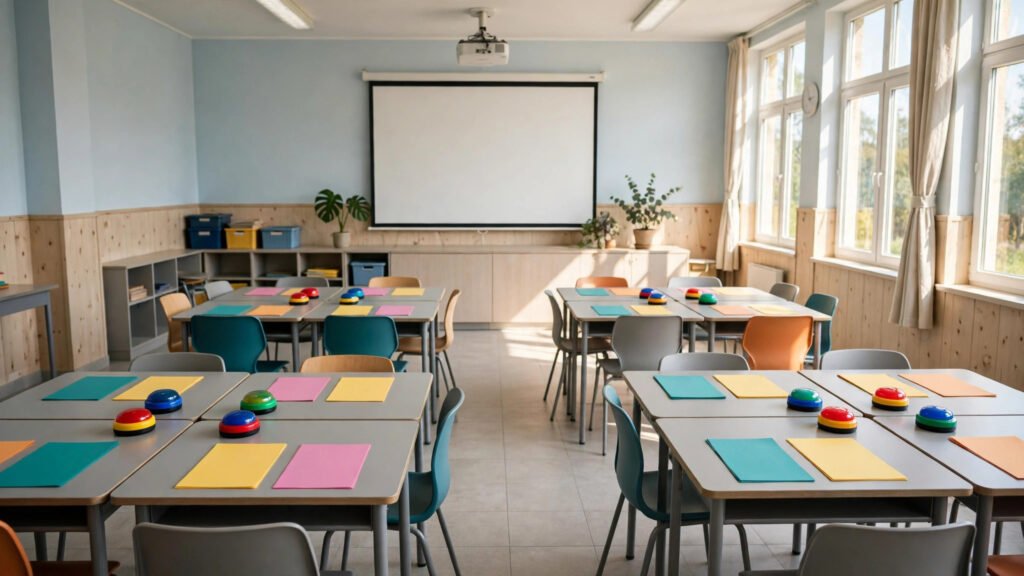
Quiz games for students have a reputation problem. To some teachers they are the reward you wheel out on the last Friday of term — fun, noisy, and faintly unrelated to learning. To students, they are the best lesson of the week. Both views miss the point. A quiz game is simply a quiz wearing a costume: the same retrieval practice, the same diagnostic value, but with points, pace, and a little theatre wrapped around it.
The trick is keeping the learning in charge of the game, instead of letting the game swallow the learning. When the points reward speed alone, the fastest guesser wins and the careful thinker checks out. When the questions demand real thought and the scoring rewards accuracy, explanation, and teamwork, a quiz game becomes one of the most effective review formats you own. Here is how to choose, build, and run them well.
quiz game for classroom
A quiz game for classroom use has to pass a test that entertainment quizzes do not: every round should leave students knowing something they did not know before, and leave you knowing something about them. Before adopting any format, ask three questions.
First, what is the thinking? If students can succeed by tapping quickly and guessing, the game is measuring reflexes. Look for formats that build in a pause — time to think, discuss, or write before answering. Second, who gets to be good at it? A game that only the top five students can win teaches the other twenty-five to stop trying. Mixed formats — some speed rounds, some accuracy rounds, some team rounds — spread success around. Third, what do you learn? The best classroom quiz games show you, question by question, what the class found hard. If the format gives you no record of answers, you are trading assessment value for noise.
Keep the rules brutally simple. Every minute you spend explaining a scoring system is a minute of learning lost, and complicated rules invite arguments that eat the lesson. Points for correct answers, a bonus for a full team agreeing, done. You can layer in extras once the basic format runs itself.

online quiz games for students
Most online quiz games for students fall into three families, and each suits a different job.
Live competitive games project questions to the whole class while students answer on their own devices, with a leaderboard updating between rounds. They are unmatched for energy and work brilliantly as a warm-up or a pre-test review. Their weakness is speed pressure: the scoring usually favors fast answers, which can punish thoughtful students and reward confident guessers. Counter it by choosing settings that weight accuracy, or by pausing after tough questions to discuss why the right answer is right.
Self-paced challenge games let students play through questions at their own speed, sometimes as homework, with progress saved between sessions. These are better for practice and fluency — times tables, vocabulary, capitals — where repetition is the point and nobody should be rushed.
Team and board-style games put small groups in control of a shared board or map, answering questions to move, earn, or build. Slower and more social, they suit deeper questions, because teammates argue their way to an answer — and that argument is itself learning.
Many general platforms now bundle these modes together, and assessment-focused tools add game-style practice on top of ordinary quizzes. If you are comparing platforms, our guide to running a classroom quiz covers the assessment side, and comparisons such as Pear Assessment vs Gimkit show how game-first and assessment-first tools differ.
quiz game for students
Running a single quiz game for students well is mostly classroom management dressed up as entertainment. Set it up like this:
- Prime the content. Tell students the topic and stakes: “This reviews the rivers unit — it tells me what to re-teach before Friday’s test.” Framing the game as preparation, not just fun, raises effort.
- Arrange teams deliberately. Mixed-ability teams of three or four work best. Letting friends cluster creates one super-team and several hopeless ones.
- Play a practice round. One silly question — the principal’s favorite food — teaches the mechanics without risking the real content.
- Pace the questions. Alternate easy confidence-builders with genuine challenges. A run of impossible questions kills momentum; a run of trivial ones bores your strongest students.
- Debrief the misses. After any question most teams got wrong, stop. Ask a team that got it right to explain their reasoning. This two-minute habit is where a game turns into a lesson.
Watch the noise with a plan rather than complaints. Decide in advance what the signal for quiet is, and celebrate the teams that follow it — points for sportsmanship sound gimmicky until you see how hard students compete for them.

game quizzes for students
Writing questions for game quizzes for students is a different craft from writing test questions. The game imposes constraints: questions must be answerable quickly, readable at a distance (often on a projector, in a hurry), and scored without judgment calls.
Keep stems short. A question that needs three readings will be answered by whoever skims fastest, not whoever knows most. Put the complexity in the options instead: four answers of similar length and style, each plausible, only one defensible. Avoid true/false almost entirely — a coin flip should not be a strategy — and use “which of these is NOT” sparingly, because the negative phrasing trips students up for the wrong reason.
Difficulty should climb within a game. Open with questions nearly everyone can answer; early success hooks the room. Place your two or three hardest questions — the ones targeting the classic misconceptions — in the final third, once energy is high and teams feel invested. And always include one question drawn from something you taught in an aside or a story: students learn that paying attention to everything, not just the textbook, pays off.
Reuse is your friend. A good question bank grows over a term: this week’s game questions become next month’s review and next term’s starter set. Writing ten strong questions once beats writing thirty weak ones every week.
education quiz games
Serious education quiz games tie their content tightly to the curriculum rather than to trivia. The strongest versions map every question to a standard or lesson objective, track which objectives each student has mastered, and feed that data back into planning. That is the difference between a game that entertains and a game that teaches in a way you can prove.
Two pitfalls catch teachers out. The first is reward drift: when points, prizes, and leaderboards become the point, students optimize for winning — copying the fastest teammate, guessing wildly on speed rounds — and the learning evaporates. Keep rewards symbolic and short-lived, and mix in cooperative goals (“can the whole class beat last week’s total?”) so success is shared.
The second pitfall is coverage illusion. A game samples a topic; it does not cover it. Ten game questions on fractions feel thorough but touch a fraction of the fraction standards. Use games to rehearse and diagnose, then confirm with quieter formats — a short written quiz or an exit check — before you conclude the class has it. Our roundup of assessment tools for teachers can help you pair game-based practice with more formal checks.
For a wider research-based view of what makes game-based learning effective, Edutopia’s coverage of game-based learning is a reliable starting point.
Making quiz games fair for every learner
A game that only suits your fastest readers is not a class activity; it is a showcase for five students. Fairness is a design job, and most of it happens before the game starts.
Reading load is the biggest hidden barrier. On-screen questions reward reading speed, so give generous answer timers — or turn timers off entirely for accuracy-based rounds. Students who process language more slowly, including English learners, often know the content perfectly well; the clock is the only thing beating them. Where the platform allows it, read questions aloud as they appear, so every student gets the information through two channels.
Offer response options beyond shouting or solo tapping. Team consensus rounds, whiteboard answers revealed on a count of three, and written “confidence votes” all let reflective students contribute before the fastest hand wins. For students who find competition genuinely stressful, roles help: scorekeeper, question reader, or the teammate in charge of the final answer check can participate fully without being on the spot.
Finally, protect the leaderboard. Public rankings motivate the top and quietly crush the bottom. Many tools let you show team standings instead of individual ones, celebrate “most improved” alongside “highest score,” or hide rankings until the very end. Use those settings. The goal is a room where every student believes the next round could go their way — because students who believe that keep thinking, and students who don’t, stop.
FAQ
Are quiz games good for all ages?
Yes, with adjusted formats. Young children need very short questions, picture-based options, and team play with heavy teacher pacing. Older students handle speed, strategy, and longer scenarios — and are often more motivated by class-versus-class or beat-the-teacher formats than by individual leaderboards.
How long should a classroom quiz game last?
Fifteen to twenty-five minutes is the sweet spot for a focused game. Shorter works as a starter; longer sessions work for end-of-unit review if you vary the rounds. Past half an hour, energy and accuracy both sag.
Can quiz games work as homework?
Self-paced modes can, and often better than a worksheet: students retry questions until they master them, and you wake up to a report instead of a pile of marking. Keep assignments short, set a completion window rather than a speed target, and remember that home device access varies — always offer an in-class alternative so the game never punishes a student for their circumstances.
Do quiz games replace regular quizzes?
No — they complement them. Games are loud, social, and speed-flavored, which makes them great for practice and review but poor at measuring individual understanding precisely. Keep quiet, individual checks in the mix for the evidence you grade and plan from.

Conclusion
Quiz games for students earn their lesson time when the game serves the learning: simple rules, questions that demand thought, formats that let everyone succeed sometimes, and a teacher who debriefs the misses. Build your bank of strong questions, vary the three game families to suit the job, and confirm with calmer assessments — and the best lesson of the week can also be one of the most useful. Start small if you need to: one ten-question game this week, reviewed properly, will teach you more about your class than a month of guessing.